Freeman Holdings expands hangar capacity across three Million Air locations | Corporate Jet Investor | CJI news
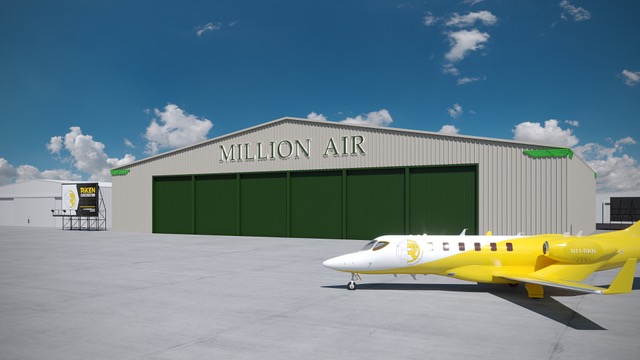
Freeman Holdings Group, the largest licensee of the Million Air FBO brand, is advancing a three-site hangar expansion strategy targeting distinct segments of the business aviation and commercial market. The projects span Moses Lake, Washington; St. George, Utah; and Orlando-Sanford, Florida, with a combined footprint exceeding 93,000 square feet of new hangar space. Each facility is calibrated to local demand rather than built to a standardized template, reflecting a deliberate effort to match capacity to the specific traffic mix at each airport. Completion timelines run from mid-2026 at Sanford to January 2027 at both Moses Lake and St. George.
The Moses Lake facility is the most atypical of the three and carries the broadest strategic implications. At 40,000 square feet with rated capacity for two Boeing 737s or a single 757, it is aimed principally at commercial and government narrow-body operators requiring long-term hangar arrangements—a segment that rarely coexists with luxury FBO infrastructure. Grant County International Airport in Moses Lake has long served as a storage, maintenance, and conversion hub for commercial aircraft, and the facility's positioning adjacent to the customs ramp suggests Freeman is also targeting ferry operations and international transit traffic. The supplemental accommodation of general aviation clients on shorter-term arrangements signals that the hangar is designed to avoid idle capacity during commercial cycle gaps, a financially sensible hedge in what remains a relatively thin GA market.
The St. George project addresses a fundamentally different pressure point: chronic hangar scarcity at a rapidly growing regional gateway. St. George Regional Airport has seen substantial traffic growth driven by proximity to Zion and Bryce Canyon National Parks, alongside increasing corporate and charter demand from a region that has attracted significant real estate and commercial development. A 22,500-square-foot hangar capable of housing a Gulfstream G650 or Bombardier Global 6000, with a 150-foot-wide door aperture, will make it the largest structure on the field and position Million Air as the clear large-cabin operator at that location. The leasing structure—spanning transient parking through exclusive sublease—allows operators using St. George on irregular schedules to access protected storage without committing to dedicated hangar ownership, which is increasingly relevant as fractional and charter operators seek flexible infrastructure arrangements at secondary airports.
The Orlando-Sanford expansion is the nearest to operational readiness, with an August 2026 target, and it occupies a strategically important competitive position. Sanford International has functioned as a relief valve for corporate and charter traffic unable or unwilling to operate through the congested airspace and ramp environment of Orlando International. A 30,500-square-foot facility targeting mid-size to large-cabin jets and corporate, charter, and transient traffic directly addresses the known bottleneck at SFB, where existing hangar supply has struggled to keep pace with business aviation growth in the broader Orlando metro area. For Part 135 operators, fractional providers, and corporate flight departments positioning aircraft for Central Florida events or client visits, the addition of credible large-cabin hangar infrastructure at an FBO with Million Air's service standards provides a viable alternative routing that was previously difficult to accommodate.
Taken together, the three projects reflect a broader trend of institutional capital flowing into FBO real estate as a long-duration infrastructure play. Hangar scarcity has become one of the most operationally consequential constraints facing business aviation, with demand for covered parking consistently outstripping new construction at airports across the United States. Freeman Holdings' expansion follows a pattern seen across the FBO sector—where large operators with multi-location networks are leveraging scale to access permitting, construction financing, and airport land-lease agreements that smaller independent operators cannot easily replicate. For pilots and flight operations managers, the practical effect over the next eighteen months will be additional options for scheduled and transient hangar access at three airports where availability has been limited, with the Moses Lake facility adding a rare example of commercial-grade narrow-body capacity being developed within a luxury FBO framework.