Why Southwest Airlines Had To Rewrite Its New Boarding System Weeks After Launch
Southwest Airlines' transition to assigned seating on January 27, 2026, represented the most significant operational restructuring in the carrier's five-decade history, and its rapid unraveling within weeks of launch exposed a fundamental misunderstanding of how open seating had functioned as a systems-level boarding mechanism. The airline simultaneously introduced eight boarding groups, three cabin seating categories, four fare bundles, a revised loyalty tier structure, co-branded credit card boarding benefits, and new checked-baggage fees — all in a single cutover. The aggregated effect was a system of compounding hierarchies that passengers, gate agents, and flight crews were expected to execute in real time, on high-frequency turns, aboard Boeing 737 fleets that were physically configured for open seating dynamics. Early reports from day-one flights indicated boarding times degraded by five to ten minutes per departure, a figure that compounds rapidly across Southwest's 800-plus daily flights.
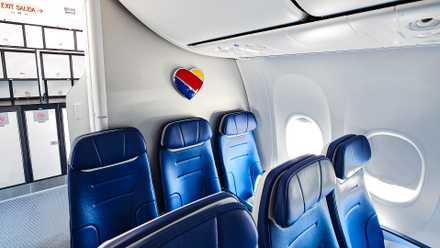
The core operational failure was architectural rather than procedural. Under open seating, overhead bin usage was self-regulating: passengers chose their row, claimed the adjacent bin space, and the natural distribution of seat selection spread bags laterally across the cabin. Assigned seating severed that link. Higher-priority boarding groups — concentrated in the forward cabin — filled forward bins first, leaving passengers in aft-assigned seats with no overhead space near their rows when they eventually boarded. The result was aisle congestion, backtracking, and a surge in gate-check activity that slowed aircraft turns and frustrated cabin crews managing compliance under time pressure. Southwest had eliminated the seat-selection race but inadvertently launched a bin-space race with the same structural urgency and none of the self-sorting efficiency.
For line pilots and flight crews operating Southwest equipment, the downstream consequences of these boarding failures are direct and measurable. Degraded boarding efficiency compresses crew rest periods on back-to-back turns, increases the likelihood of late pushbacks that cascade into schedule pressure, and elevates passenger frustration levels that crews absorb during the boarding process itself. Gate agents calling multiple queuing groups simultaneously — a practice that echoed United Airlines' criticized pre-board staging model — created gate-area congestion that interfered with jetbridge access and ground crew coordination. Any carrier operating high-frequency, short-haul domestic routes at Southwest's volume cannot absorb even marginal boarding time increases without schedule propagation effects that accumulate across hubs by mid-afternoon.
The Southwest experience is instructive for the broader industry because it illustrates the integration risk embedded in simultaneous commercial and operational change. Delta, United, and American have each modified boarding sequences and fare structures incrementally over years, building agent familiarity and passenger expectation management iteratively. Southwest compressed what would normally be a multi-year transition into a single launch date, and the complexity of its new customer hierarchy — where a traveler's boarding position could be determined by any combination of fare class, elite status tier, credit card membership, or seat category — proved too opaque for the gate environment to execute cleanly at speed. The airline's April 2026 loyalty-focused refinements signal that further adjustments remain likely, as the operational reality of assigned seating continues to surface legacy infrastructure constraints the original system was designed to avoid.
For corporate and charter operators watching from outside Southwest's model, the episode reinforces a foundational truth in aviation operations: boarding sequence design is not a customer experience preference but a systems engineering problem. The interaction between seat assignment, bin allocation, passenger load factor, cabin crew positioning, and pushback timing constitutes a closed system, and changes to any single variable propagate through the others. Southwest is now engaged in the iterative work of rebalancing that system under public scrutiny, on live operations, with a customer base that spent fifty years learning a different set of behavioral expectations.









 Read original article