Luxurious, But No First Class: Inside This Start-Up Airline's New Boeing 787-9 Cabin Configuration
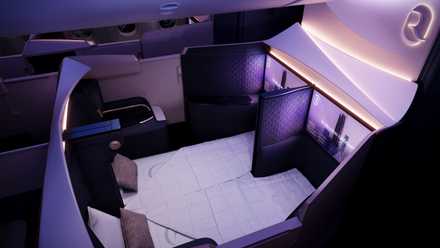
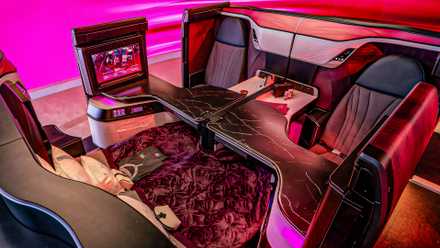
Riyadh Air's revelation of its Boeing 787-9 cabin configuration marks one of the more strategically calculated product launches in commercial aviation's current cycle of premium-class consolidation. The Saudi start-up, operating under the broad mandate of the Kingdom's Vision 2030 initiative to triple annual passenger traffic and establish Riyadh as a global aviation hub, has deliberately designed its first widebody fleet without a traditional first-class cabin. In its place, the airline fields 24 Safran Unity business-class suites arranged in a 1-2-1 configuration with 52-inch privacy walls, supplemented by four forward "business elite" suites featuring 32-inch 4K OLED monitors and retractable center dividers that convert into a double bed. CEO Tony Douglas has framed the product as a "Maybach versus S-Class" value proposition — a business cabin that delivers first-class specifications without a first-class fare ceiling. The industrial design, executed by PriestmanGoode, draws from the geometry of the King Abdullah Financial District and is integrated coherently through a canopy twist motif across seat shells and cabin monuments, producing a visually consistent interior that goes beyond the surface-level branding that characterizes many new-entrant airline products.
The yield logic underpinning this configuration is directly relevant to how operators and aircraft acquisition professionals should understand the economics of the 787-9 airframe going forward. Traditional first-class cabins on routes where a $15,000 price point cannot be consistently sustained produce structural load-factor risk — high per-seat cost with chronic underutilization. Riyadh Air's approach mirrors what American Airlines executed with its 787-9P variant, which entered service in late 2025 with 51 Flagship Suite seats in a 1-2-1 layout and no dedicated first class, increasing premium capacity by approximately 65 percent over its predecessor configuration. United Airlines has made comparable moves on its 787-9 Elevated Interiors aircraft, fielding 56 Polaris business seats with no first-class section. The pattern is no longer an outlier strategy — it represents a maturing industry consensus that the business-class suite, when engineered to first-class dimensional standards, captures the high-margin corporate traveler segment more efficiently than a hybrid three-class cabin can. For Part 91K and charter operators benchmarking against the airline industry's premium evolution, the convergence of suite-class privacy, full-flat beds, and 4K displays into what is technically classified as business class compresses the perceived differentiation between commercial and private aviation for the price-sensitive ultra-high-net-worth traveler.
For professional pilots and aviation operators, Riyadh Air's entry into commercial service carries operational significance beyond the cabin product itself. The airline's 787-9 fleet represents new route competition on Middle Eastern hub-and-spoke corridors where Emirates and Qatar Airways currently dominate, directly affecting traffic flows at major connecting hubs including Dubai and Doha — airports through which a substantial proportion of business aviation activity in the Gulf region is coordinated. Saudi Arabia's Vision 2030 aviation investment includes the parallel development of NEOM's Sindalah Airport, the expansion of King Salman International Airport in Riyadh, and increased GACA certification activity, all of which will alter slot availability, airspace structure, and handling infrastructure for foreign operators routing through the Kingdom. The airline's choice to omit wireless charging in favor of dual USB-C and USB-A wired ports — aligned with Saudi Arabia's 2025 USB-C mandate — is a minor but telling signal of how the airline intends to operate: decisions driven by measurable passenger utility over marketing optics. Riyadh Air's commercial debut, when it occurs, will test whether a no-legacy-overhead start-up can sustain the operational reliability and network depth necessary to convert a superior product into a durable competitive position against carriers with decades of alliance infrastructure and bilateral agreements already in place.










 Read original article