This Aircraft Defied A Decade Of Cost Overruns To Become The Most Widely Deployed Stealth Fighter In History
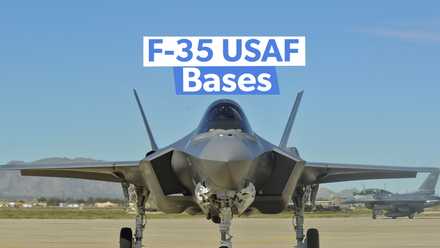
The F-35 Lightning II stands as both the most widely deployed stealth fighter in aviation history and the most expensive weapons program ever undertaken by any government, with a projected lifecycle cost now exceeding $2 trillion across a 77-year service life. Originally conceived in the 1990s as a tri-service solution to replace aging platforms across the Air Force, Marine Corps, and Navy — the F-16, A-10, AV-8B Harrier, and F/A-18 among them — the program launched in 2001 with an acquisition estimate of $233 billion and a promise that shared components across three variants would drive down unit costs and simplify logistics. Neither projection survived contact with the realities of developmental aviation. Acquisition costs have since risen to $485 billion, and sustainment projections add another $1.58 trillion, figures documented repeatedly by the Government Accountability Office across two decades of oversight reports.
The central mechanism behind the program's cost explosion was a procurement strategy called concurrency, in which Lockheed Martin began manufacturing aircraft in volume before developmental testing was complete. Pentagon planners believed the approach would accelerate delivery timelines, but the practical result was the opposite: as testing revealed structural and software deficiencies, aircraft already produced required expensive retrofitting, and the cost of post-manufacture modifications consistently exceeded what resolution during development would have required. The F-35B variant's short takeoff and vertical landing system introduced particularly severe engineering constraints that rippled across all three variants, eroding the commonality savings that had justified the single-platform approach in the first place. By the time the full scale of these overruns became apparent, production work had already been distributed across 45 U.S. states and eight partner nations, creating a political and industrial constituency large enough to make program cancellation functionally impossible regardless of cost performance.
The sustainment picture represents the program's most consequential long-term vulnerability, and one with direct relevance to any aviation operator studying how maintenance contracts and data rights shape operational economics. The Pentagon does not hold the technical data rights necessary to perform many maintenance tasks on the F-35 independently, leaving Lockheed Martin in effective control of a sustainment market projected to exceed $1.5 trillion over the aircraft's service life. The GAO has flagged this dependency in multiple reports, noting that the absence of competitive pressure in the sustainment chain eliminates one of the primary cost-control mechanisms available in normal procurement environments. For military aviators who will fly the F-35 throughout careers spanning the next several decades, this dynamic means operational availability and readiness will remain tied to a single contractor's performance in ways that no competitive bidding process can currently correct.
The F-35 program's trajectory carries broader implications for professional aviation well beyond the military services that operate it. The aircraft now forms the backbone of allied air power across NATO and the Indo-Pacific, with partner nations including the United Kingdom, Australia, Japan, Israel, and the Netherlands operating or contracting variants. The military-to-civilian pilot pipeline that has historically fed regional and major carriers with instrument-rated, high-performance aviators increasingly runs through F-35 training pipelines, meaning the aircraft's long-term operational health has downstream effects on commercial aviation workforce development. More broadly, the program illustrates the structural risks that emerge when platform complexity, political entrenchment, and proprietary sustainment ecosystems converge — dynamics that, at smaller scale, are recognizable to any operator managing avionics upgrade cycles, EASA or FAA supplemental type certificate timelines, or OEM-controlled maintenance agreements on business jet fleets. The F-35 is an extreme case, but the tensions it embodies between acquisition ambition, real-world engineering constraints, and lifecycle cost control are not unique to defense procurement.





 Read original article