Waypoint: Making The Case For Emergency-Response EVTOLs
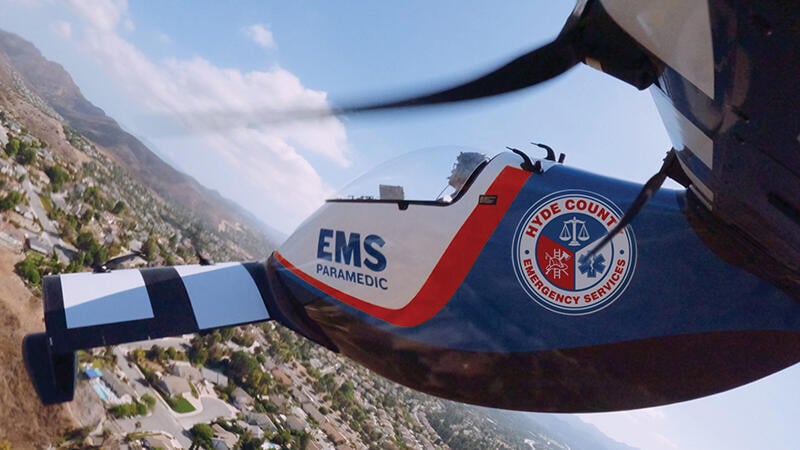
Pivotal, a U.S. eVTOL startup preparing to deliver its single-seat Helix ultralight aircraft, has launched a structured proof-of-concept program with Hyde County, North Carolina, to demonstrate that Part 103-compliant eVTOL aircraft can function as first-responder platforms in medically underserved rural communities. The program deploys two BlackFly aircraft — production predecessors to the Helix — operated by paramedics who are already certificated pilots, with the explicit mission of delivering a first responder with a life-saving kit to the scene of a time-sensitive 911 call faster than a ground ambulance. Hyde County presents a near-ideal test environment: flat coastal terrain, Class G airspace, an aging population of roughly 5,000 generating approximately 1,000 emergency calls per year, and average ambulance response times exceeding one hour — rising to two hours when barrier island ferry crossings are involved. The program is structured in deliberate phases, beginning with replicated flights over past emergency routes to measure time-to-patient-care before any live operational deployment.
The regulatory architecture underpinning the project is as significant as the aircraft itself. By designing the Helix to comply with FAA Part 103 ultralight rules, Pivotal has deliberately bypassed the type certification process, eliminating one of the most time-consuming and capital-intensive barriers that have slowed competing eVTOL developers. The tradeoff is operational constraint — single-seat, day VMC only, limited weight and speed — but for the specific mission profile being tested, those constraints are largely acceptable. The more consequential regulatory hurdle is the public aircraft declaration, which Hyde County must obtain to allow the BlackFlys to legally respond to 911 calls. Under federal statute, public aircraft operations are reserved for governmental functions and exempt from certain FAA certification requirements, but the declaration process itself requires FAA concurrence. Pivotal's CEO has identified this step as the critical path item before live operations can begin, and its resolution will be closely watched by other operators exploring similar mission profiles.
For professional pilots and aviation operators, the Hyde County project surfaces a question that has remained largely theoretical: whether the eVTOL category can generate operationally credible, revenue-adjacent use cases outside of urban air mobility corridors. The five major eVTOL manufacturers pursuing type certification — Joby, Archer, Wisk, Lilium's successors, and Beta Technologies among them — have concentrated resources on multi-passenger aircraft designed for high-density metropolitan markets. Pivotal's approach inverts that model entirely, trading range, payload, and certification status for simplicity, rapid deployability, and a mission set that serves populations those aircraft will likely never reach. The fact that the three Hyde County paramedics were already pilots is not incidental — it speaks to a practical selection problem that any broader rollout will need to address, namely the overlap between clinical responder training and aviation currency.
The broader implication for the aviation industry is that the first durable eVTOL use case may not emerge from urban corridors at all, but from the structural failures of rural emergency services infrastructure. Approximately 5,000 ambulance deserts exist across the contiguous United States, a figure that reflects both geographic isolation and systemic underfunding of rural EMS. If the Hyde County template produces documented life-safety outcomes under controlled conditions, it creates a reproducible model that county and municipal emergency services agencies can evaluate with quantifiable metrics rather than speculative projections. That replicability is central to Pivotal's stated strategy: the company is not attempting to operate these missions itself, but to design a franchisable operational template that other organizations can adopt. For the broader eVTOL sector, which continues to face investor skepticism about near-term revenue paths, a validated public-safety use case would represent a meaningful proof point — one grounded in governmental procurement cycles rather than consumer demand forecasting.
The Hyde County project also carries weight for the regulatory community's evolving posture toward advanced air mobility. The FAA's handling of the public aircraft declaration request will signal how the agency intends to treat Part 103 eVTOL operations in public-service contexts — a category that existing rules were not written to anticipate. How the agency resolves the tension between ultralight operating limitations and governmental mission requirements could establish precedent affecting not only Pivotal's program but any operator seeking to deploy certificated or uncertificated eVTOL assets in emergency, law enforcement, or disaster response roles. Operators and flight departments monitoring the eVTOL landscape should track this program not as a curiosity but as an early indicator of where regulatory boundaries for the entire category will eventually be drawn.









 Read original article