Opinion: Is There a Business Jet Market Ceiling?
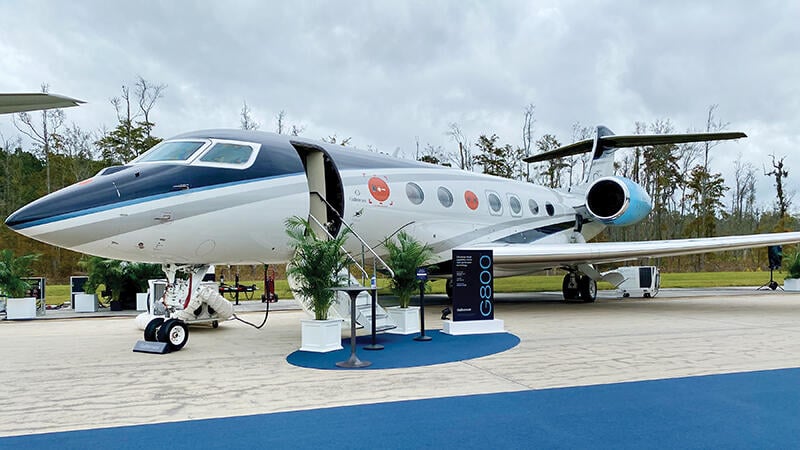
The ultra-large cabin business jet segment has demonstrated a near-unique economic characteristic over the past five decades: the complete absence of price elasticity at the top of the market. As AeroDynamic Advisory managing director Richard Aboulafia chronicles in a new book co-authored with Kevin Michaels, the inflation-adjusted sticker price for the most capable business jets has roughly tripled since the 1960s — from approximately $30 million for the Gulfstream GII and Lockheed Jetstar to the current generation of G700/800, Global 8000, and Falcon 10X aircraft that transact well above $75–85 million before interior and options work. Critically, each successive price increase has been met with equal or greater demand, with nearly 1,000 deliveries in the current high-end tier generating more than $80 billion in revenue. This pattern distinguishes business aviation's apex segment from virtually every other capital goods market, where higher prices typically suppress volume.
The competitive architecture that has emerged from this progression is what Aboulafia terms a "permanent triad" — Gulfstream, Bombardier, and Dassault locked into a three-way competition where no participant can afford to cede technological leadership. The mechanism is straightforward: when a top-tier customer is offered a superior new product, the displaced manufacturer loses not just the new sale but the trade-in value of the legacy aircraft. Both Bombardier and Dassault experienced this dynamic acutely when Gulfstream's G650 reset the market around 2012, and neither is positioned to absorb a repeat. For flight departments and operators at this level, the practical consequence is a durable, well-resourced competitive environment that continues to push cabin technology, range, and systems integration forward — characteristics that directly affect crew workload, passenger productivity, and operational flexibility on ultra-long-range missions.
The more strategically significant question Aboulafia raises concerns the vector of future development, and the constraints he identifies will be familiar to pilots who operate at the top of the current fleet. Supersonic business transport has been attempted repeatedly and consistently fails the value proposition test: narrower cabins, reduced range, and the aerodynamic and thermal complications of transonic and supersonic flight produce an aircraft that is faster but operationally inferior on the criteria that actually drive purchase decisions. Current cruise speeds near Mach 0.925 already exceed all commercial transport aircraft in service. Range is effectively unlimited for all practical routing, cabin volume is approaching widebody airliner dimensions, and service ceilings are as high as airspace and physiology practically permit. The implication for operators is that the next clean-sheet generation — notional G900, Global 9000, or Falcon 11X programs — will likely represent refinement rather than revolution: incremental range extension, further cabin pressurization improvements, enhanced connectivity, and systems consolidation rather than any single transformative capability.
For corporate flight departments and Part 91 operators evaluating long-term fleet planning, Aboulafia's framing carries a practical implication that extends beyond the ultra-large market. The same dynamic — incremental capability growth, sustained pricing power, and brand-locked competitive triads — is visible across the super-midsize and large-cabin segments where Cessna, Dassault, Embraer, and Bombardier compete with the Longitude, Falcon 6X, Praetor 600, and Challenger 350/650 families. Acquisition cycles in business aviation have always rewarded operators who time their purchases around genuine capability discontinuities rather than incremental updates, and Aboulafia's analysis suggests the next true discontinuity at the top of the market may be further out than OEM marketing cadences imply. Operators holding current-generation G650ERs, Global 7500s, or Falcon 8Xs are, by the author's own assessment, flying aircraft that are already pushing against most of the practical performance envelopes that matter on real-world missions.








 Read original article