20/Twenty: Bombardier’s Challenger Is A Champ
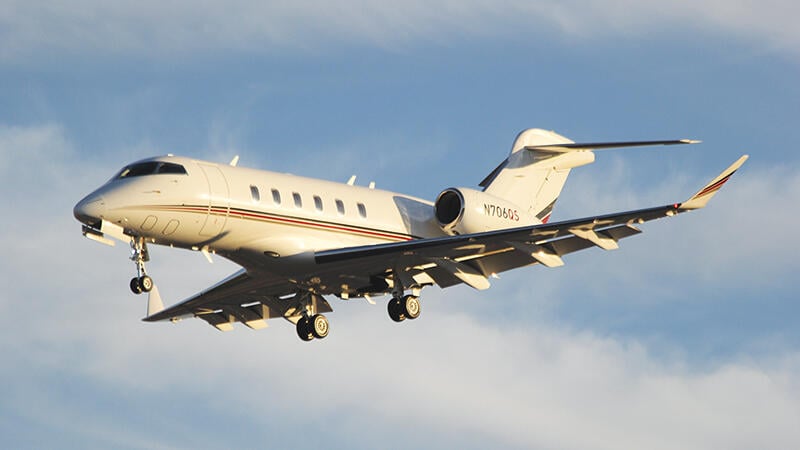
The Bombardier Challenger 300 series has established itself as the most operationally active business jet in North American aviation, with WingX data recording 210,000 combined Challenger 300 and 350 departures in 2024 alone—a figure that by February 2026 was still running at roughly 14,630 monthly departures. That level of utilization, sustained across more than two decades since the original Challenger 300 entered service in 2003, reflects the platform's singular combination of super-midsize cabin volume, transcontinental range of 3,200–3,400 nm, and Mach 0.83 cruise performance in a package that large fractional operators like NetJets and Flexjet can deploy reliably at 400-plus hours per year. With more than 1,000 frames delivered across three generations and 428 of the 431 Challenger 350s produced still in active service, the type represents one of the most successful sustained production runs in modern business aviation.
For pilots and operators evaluating the distinction between the 300 and 350, the differences are operationally meaningful despite an exterior profile that is nearly identical between the two variants. The 350's canted winglets extend span by approximately five feet and enable direct climbs to FL430—two thousand feet above the 300's certified ceiling of FL410—a capability that matters in busy airspace where step climbs consume fuel and add to controller workload. The Honeywell HTF7350 engines powering the 350 each produce 497 pounds more thrust than the HTF7000s on the original airframe, with the gain attributed primarily to software updates; that additional thrust contributes directly to the 145-nautical-mile range improvement over the 300. The cockpit retains a Collins Pro Line 21 suite with four large displays, synthetic vision, MultiScan weather radar, and dual FMS—a well-understood and broadly trained avionics platform across the professional pilot community. Pilots evaluating specific airframes should note that Safe Flight AutoPower autothrottles are available only via service bulletin beginning at Serial No. 20875 and as factory standard from Serial No. 20937; equipped aircraft command a price premium in the pre-owned market, and retrofits are generally not considered economically viable.
The pre-owned Challenger 350 market reflects the broader tightness that has characterized business jet transactions since the post-pandemic demand surge. Retail values for the 350 range from $15.5 million to $19.5 million for a type that sold new between $26 million and $27 million—a retained-value profile that underscores fleet scarcity. At times, as few as seven examples have been available simultaneously, with average time-on-market measured at approximately 100 days. For fractional operators, flight departments, and charter certificate holders considering acquisition or fleet expansion, that liquidity constraint means procurement windows are narrow and negotiating leverage is limited. Condition-monitored Honeywell engines enrolled in the manufacturer's Maintenance Service Plan reduce the interval-based cost exposure that operators face with hard-time engine programs, contributing to the type's reputation for predictable direct operating costs—frequently cited as the lowest in the super-midsize class, though not by a wide margin.
The Challenger 350's sustained relevance in a competitive segment that includes the Cessna Citation Longitude, Embraer Praetor 600, and Gulfstream G280 speaks to Bombardier's success in identifying the correct balance of range, cabin environment, and operating economics for the fractional and charter market. The flat-floor cabin measuring 7 feet 2 inches wide, 6 feet 1 inch tall, and over 25 feet long—combined with the Lufthansa Technik NICE HD cabin management system and 106 cubic feet of baggage stowage—addresses the passenger experience expectations that drive repeat utilization for fractional card holders and charter clients. One notable limitation operators should account for mission-planning purposes is the absence of a vacuum toilet system; the Challenger 350 is the only aircraft in its competitive set relying on a chemical lavatory, which constrains menu and catering decisions on longer legs. The arrival of the third-generation Challenger 3500 has not diminished demand for the 350, and Bombardier's three-decade platform continuity positions the lineage as a durable element of the business aviation fleet well into the next decade.





 Read original article