BizJets Earn Their Stipes In Military Service
Business jets have transitioned from symbols of corporate mobility into foundational platforms for military special missions, with the United States and allied nations accelerating investment in heavily modified Bombardier, Gulfstream, and Challenger airframes to perform roles once reserved for purpose-built military aircraft. The central driver is straightforward operational physics: business jets cruise at altitudes above 40,000 feet, well above most tactical traffic and weather, giving sensors, radars, communications relays, and electronic warfare systems the elevation and standoff distance needed to function effectively over wide geographic areas. The Northrop Grumman E-11A BACN, built on a Bombardier Global 6000, exemplifies the utility — the aircraft essentially functions as an airborne internet router, bridging disparate communications architectures across multi-domain strike packages. The Army's HADES program, built on Global 6500 airframes and worth up to $991 million, extends the concept into ground target detection and long-range fires coordination, while the nascent Air Force Looking Glass - Next program signals intent to place nuclear command-and-control functions aboard a business jet class platform.
The commercial bizjet airframe offers defense planners a combination of attributes that legacy military aircraft cannot match cost-effectively: high service ceilings, intercontinental range, relatively low acquisition cost compared to purpose-built reconnaissance platforms, mature avionics architectures, and robust global support infrastructure. Because Bombardier, Gulfstream, and Textron Aviation maintain worldwide maintenance and parts networks originally built to support corporate flight departments, the military operators of these modified aircraft inherit a supply chain that purely military platforms often lack. The contractor-owned, contractor-operated model seen in programs like Athena, Artemis, and ARES further reduces the burden on uniformed aviation units by placing aircraft airworthiness, scheduling, and crewing responsibilities on defense contractors, allowing the services to access persistent ISR and electronic warfare capability without absorbing the full lifecycle cost of a dedicated military fleet.
For professional pilots and aviation operators, the proliferation of special mission bizjets introduces practical airspace and operational considerations that are increasingly relevant. These aircraft routinely operate under Special Use Airspace designations, temporary flight restrictions, and classified routing, but they also transit the same Class A structure used by commercial and business aviation operators. The E-11A BACN suffered a high-profile crash in Afghanistan in 2020, killing two crew members and drawing attention to the risks inherent in sustained high-altitude operations in contested environments — a reminder that the civilian certification baseline of these airframes does not fully translate to military mission profiles. Pilots flying in regions where these assets are active — the Middle East, the Indo-Pacific, and increasingly Eastern Europe — may encounter unusual NOTAMs, frequency management constraints, or ATC coordination requirements tied to their operations.
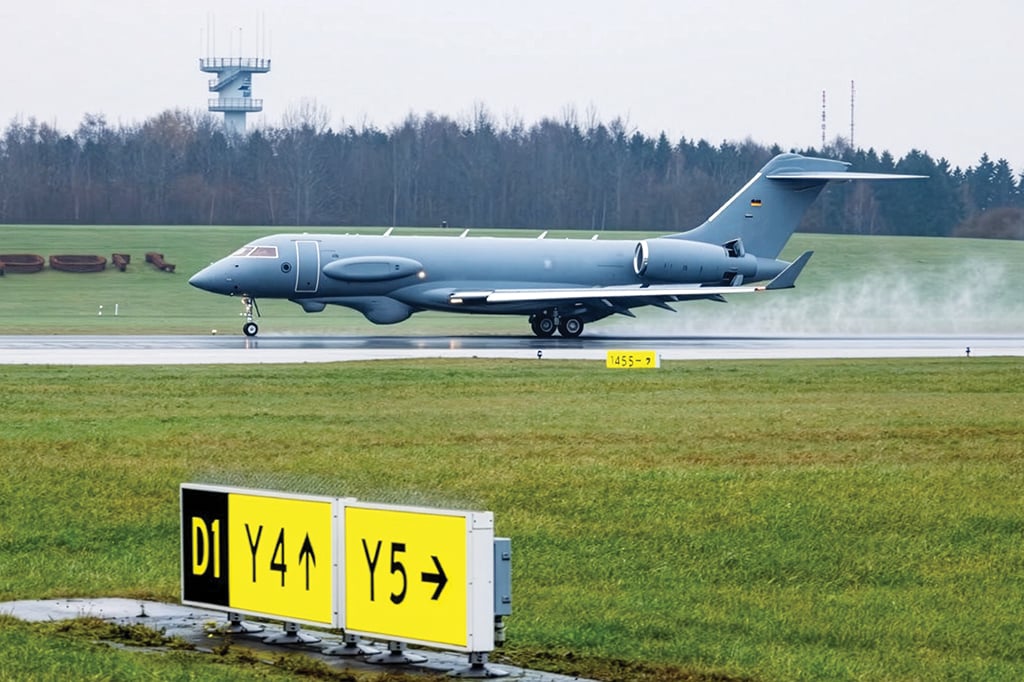
The international dimension of the special mission bizjet market is expanding rapidly, with Australia's MC-55A Peregrine, Germany's Pegasus, the UAE's GlobalEye, and Finland's SNC-built RAPCON-X variant illustrating that this is no longer a predominantly American phenomenon. That geographic spread carries implications for aircraft type ratings, international maintenance standards, and airspace sovereignty that affect both military and civilian operators. The Gulfstream G550 and Global 6000/6500 platforms underpinning many of these programs are also among the most common ultra-long-range business jets flown by corporate flight departments globally, meaning the airframe type knowledge held by thousands of civilian-trained pilots is directly relevant to the military mission world. As defense budgets in NATO nations and Indo-Pacific partners continue shifting toward high-altitude ISR and electronic warfare capability, the overlap between the professional business aviation workforce and the specialized military operator community is likely to deepen, creating both employment pathways and airspace complexity that operators will need to anticipate.











 Read original article