Here’s How Much More Range The Airbus A350-1000 Has Compared To The Boeing 787-9
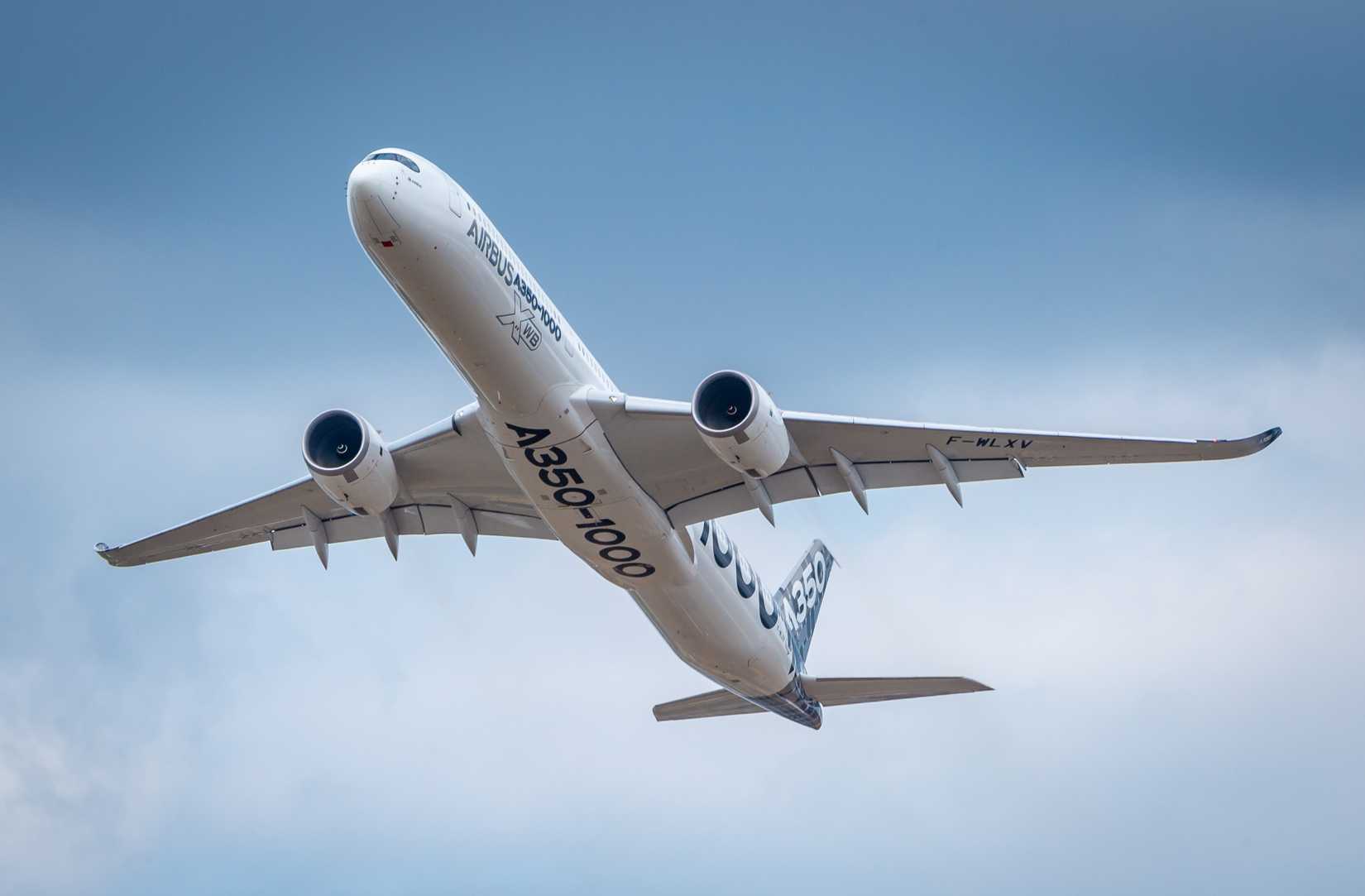
The Airbus A350-1000 carries a manufacturer-published range advantage of approximately 1,400 nautical miles over the Boeing 787-9, with Airbus citing roughly 9,000 nautical miles against Boeing's catalog figure of approximately 7,565. The two aircraft occupy meaningfully different weight classes: the A350-1000 operates at a maximum takeoff weight between 308 and 322 tonnes, compared to the 787-9's approximately 250 tonnes, a delta of 60 to 70 tonnes that directly reflects differences in fuel capacity, structural design, and payload ambition. The A350-1000 carries more than 168,000 liters of usable fuel, powering Rolls-Royce Trent XWB-97 engines purpose-built for high-thrust, long-endurance operations. The 787-9, by contrast, offers a choice of GEnx or Trent 1000 powerplants optimized for efficiency across a wider range of sector lengths. Both types cruise near Mach 0.85 and rely heavily on composite airframes, but they represent fundamentally different design philosophies: the A350-1000 was conceived from the outset to absorb the most demanding ultra-long-haul missions without compromise, while the 787-9 was engineered to deliver strong economics across a broad intercontinental network.
For airline operations planners and crews flying these types, the practical implications of the range gap extend well beyond simple distance calculations. Catalog range figures are computed at specific payload assumptions, cabin configurations, and fuel reserve standards, meaning real-world operational range fluctuates considerably. A premium-heavy A350-1000 on Japan Airlines' Tokyo Haneda to New York JFK service, or Qatar Airways' Doha to Los Angeles sector — a flight that can approach 15 hours with seasonal westbound headwinds — still carries meaningful range buffer that allows dispatchers to plan with higher alternate fuel loads and more robust diversion options. The 787-9, operating Qantas' Perth to London Heathrow or United's San Francisco to Singapore services, is operating near the upper boundary of its certified envelope on those missions. Crews and dispatchers on those operations routinely manage tighter fuel margins, with less flexibility to absorb significant headwind deviations or last-minute payload additions without affecting contingency planning. The A350-1000's additional margin thus functions not merely as a marketing figure but as an operational buffer that translates directly into dispatch reliability and crew decision-making latitude on the most demanding sectors.
The article also surfaces an important distinction that working operators understand well: range figures and payload capability interact in ways that are rarely linear. An A350-1000 configured with a high-density business class and strong cargo revenue loads may not approach its theoretical maximum range, while a lightly configured 787-9 on a favorable routing with tailwinds can occasionally extend beyond its catalog number. Airlines such as British Airways, which deploy the A350-1000 on routes to Cape Town, Nairobi, and Toronto from London Heathrow, are leveraging the type's combination of extended range and high payload ceiling simultaneously — a pairing the 787-9 cannot fully replicate on the longest sectors when cargo demand is high. This payload-range trade-off is especially consequential on high-yield transoceanic routes where carriers need to sustain premium cabin products and meaningful belly cargo revenue without reducing one to preserve the other.
Broader trends in widebody acquisition and fleet strategy underpin this comparison. The commercial aviation industry's continued push toward twin-engine ultra-long-haul operations — enabled by ETOPS authorizations extending to 330 minutes and beyond — has elevated range and fuel efficiency to the top of airline decision criteria. The A350-1000 and 787-9 represent the two dominant widebody platforms in this competitive space, with the A350-1000 targeting the small but high-value segment of routes exceeding roughly 8,000 nautical miles where the 787-9 begins to encounter genuine operational constraints. For Part 91K and Part 135 business aviation operators, the underlying engineering narrative carries parallel relevance: the relationship between certified range, operational payload, fuel load, and diversion planning applies directly to long-range business jet operations, where similar trade-offs between advertised range and real-world mission capability govern flight planning on transatlantic and transpacific positioning flights.










 Read original article