Jet Aviation Introduces U.S. Drone Inspections
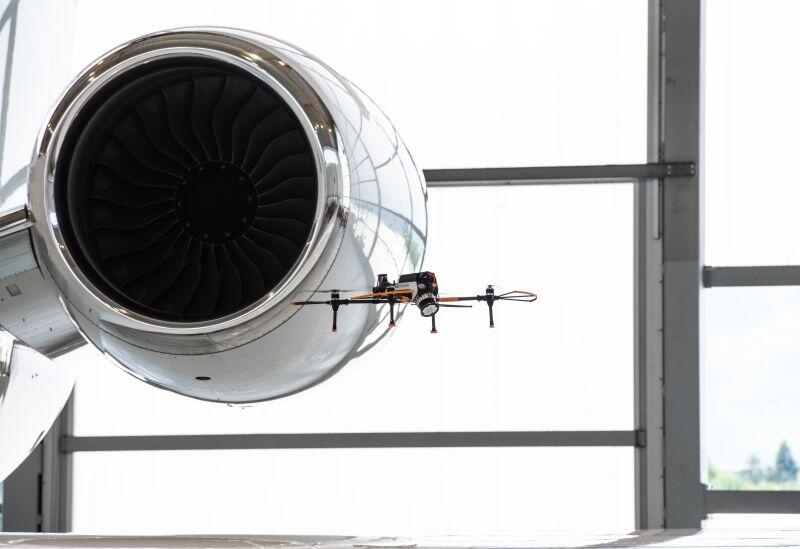
Jet Aviation has expanded its automated drone inspection service to the United States, making AI-assisted exterior aircraft assessments available to its managed fleet and FBO customers across 12 domestic locations. The service, developed in partnership with French technology firm Donecle, uses drone platforms combined with artificial intelligence to generate comprehensive digital maps of an aircraft's exterior surface. Originally deployed at Jet Aviation's Basel, Switzerland headquarters and MRO hub in 2023 and formally approved by Switzerland's Federal Office of Civil Aviation for general visual inspections by imagery in 2024, the U.S. rollout represents the first transatlantic expansion of the program. The service covers a broad range of business jet and narrowbody aircraft types, as well as select widebody aircraft, and is positioned for use in pre-purchase evaluations, insurance claims, and warranty documentation.
For operators and flight departments, the practical significance lies in the quality and consistency of exterior condition documentation. Traditional walk-around and pre-purchase inspections depend heavily on inspector experience, lighting conditions, access equipment availability, and time constraints — all variables that introduce inconsistency into the process. Drone-based AI inspection produces a standardized, repeatable digital record of the airframe exterior that can be timestamped and archived, creating a defensible evidentiary baseline for warranty claims, insurance disputes, or pre-transaction negotiations. For aircraft under management agreements, this kind of systematic documentation can also support residual value protection over the lifecycle of the asset, an increasingly important concern as business jet values remain elevated and transaction scrutiny intensifies in the resale market.
The service is currently categorized as non-regulated, meaning it supplements rather than replaces FAA-required maintenance inspections performed by licensed technicians. This distinction is operationally important: the drone imagery does not carry airworthiness sign-off authority and cannot substitute for an AMT's hands-on inspection in an approved maintenance program. What it does provide is a high-resolution exterior condition record useful in the administrative and commercial dimensions of aircraft management — due diligence, insurance underwriting, and fleet tracking — where documented photographic evidence has long been underutilized relative to its value. As Part 91K and Part 135 operators continue to professionalize fleet management practices under pressure from insurers and lenders, tools that generate objective, auditable exterior records fill a genuine operational gap.
Broader context places this development within an accelerating trend of AI-assisted inspection technology entering business and commercial aviation. Major MRO providers and airlines have been piloting drone and computer-vision inspection programs for several years, particularly for fuselage skin, control surfaces, and engine nacelles — areas where visual anomalies are difficult to detect at standard walk-around distances. Donecle has established itself as one of the more active players in this niche, with deployments across European MRO facilities and airline operators. Jet Aviation's adoption and U.S. expansion signals that the technology has matured sufficiently for deployment in a premium business aviation services context, where customer expectations for precision and documentation are high. As regulatory frameworks in the U.S. catch up — the FAA has been developing guidance on the use of drones and computer vision in maintenance-adjacent operations — services like this one are likely to evolve from optional commercial add-ons toward formally recognized components of aircraft inspection workflows.






 Read original article