BizJets Earn Their Stripes In Military Service
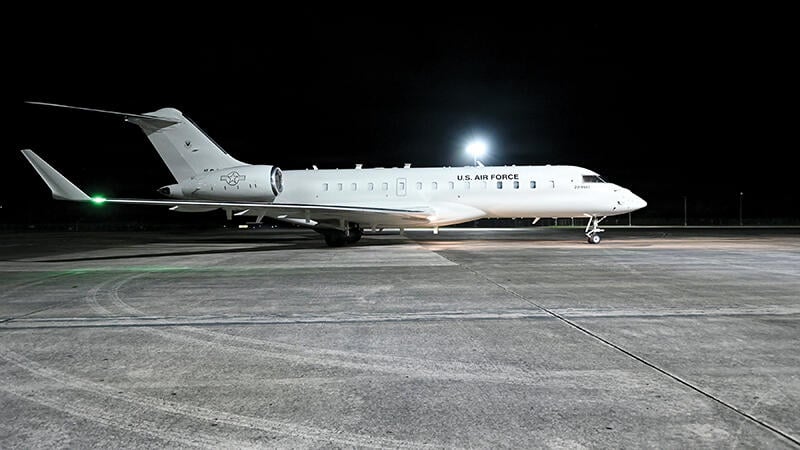
Business jets have evolved far beyond executive transport into frontline military assets, with the United States and allied nations increasingly converting high-altitude, long-endurance platforms like the Bombardier Global 6000, Global 6500, and Gulfstream G550 into sophisticated special mission aircraft capable of battlefield networking, signals intelligence, electronic warfare, and airborne early warning. The Northrop Grumman E-11A Battlefield Airborne Communications Node, based on the Bombardier 6000, exemplifies the trend by functioning as an airborne router that bridges disparate military communication networks across coalition platforms during complex operations. The U.S. Army's HADES program, built around Sierra Nevada Corporation-modified Global 6500s and backed by a contract worth up to $991 million, adds ground target detection and long-range fires support to the list of missions. Meanwhile, the Air Force's nascent Looking Glass-Next program signals that business jet airframes may soon inherit one of the most consequential missions in American national security: the airborne command post authority for nuclear ICBM launches, a role previously shared by the Navy's aging Boeing E-6B Mercury fleet.
The operational logic behind this shift is straightforward and has clear implications for the aerospace industry and aircraft manufacturers. Business jets in the Global and Gulfstream class routinely operate above 45,000 feet, providing line-of-sight communication and sensor coverage that low-altitude platforms cannot replicate, while their range and cruise speeds allow rapid deployment to contested regions without the logistics burden of larger purpose-built military aircraft. Bombardier's Global family in particular has become the preferred host airframe for multiple independent programs across the U.S. Army, Air Force, UAE, Germany, and beyond, validating the platform's structural margins, cabin volume, and systems architecture as sufficiently robust to support dense mission equipment packages. The diversification of integrators—Sierra Nevada, L3Harris, Leidos, Hensoldt—competing on both domestic and international bids underscores that the special mission bizjet market has matured into a distinct and competitive defense sector.
For professional aviators operating in the business jet world, the military special mission trend carries several practical dimensions. First, it reinforces the long-term production viability and parts support ecosystem for Bombardier Global and Gulfstream G550 series aircraft, given that government contracts incentivize sustained manufacturing lines and engineering investment in those platforms. Operators and flight departments tracking fleet replacement cycles can draw some confidence from the depth of military demand for these airframes. Second, pilots transitioning between civil and military or government contractor flight operations—a common career pathway in the Part 135 and government charter space—will encounter these modified platforms with additional weight, altered center-of-gravity envelopes, and non-standard avionics configurations that demand thorough type-specific ground training beyond standard factory courses.
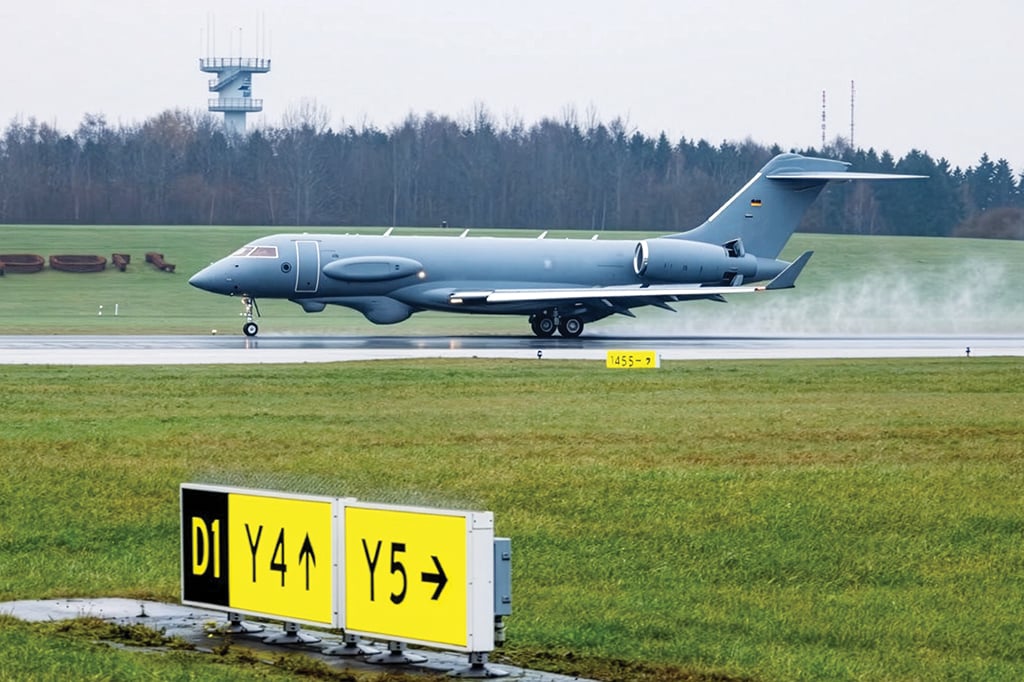
The broader trend also reflects a deliberate strategic calculation by defense planners to field survivable, flexible ISR and command-and-control capacity without the cost and lead time of purpose-built military designs. Programs like Australia's MC-55A Peregrine and Germany's Pegasus demonstrate that this is not a uniquely American approach but a NATO and partner-nation doctrine taking hold simultaneously across multiple theaters. As unmanned platforms absorb more of the tactical reconnaissance workload, manned business jets are moving up the mission stack toward higher-value, higher-complexity roles requiring persistent human judgment—nuclear command authority being the most extreme example. That trajectory suggests the special mission bizjet segment will continue expanding in both capability and strategic importance through the 2030s, with implications for airframe demand, modification center workloads, and the specialized pilot and crew communities that support these operations globally.








 Read original article