Airbus Delays More A350s As Ex-Spirit Plant Can't Deliver Critical Fuselage Parts
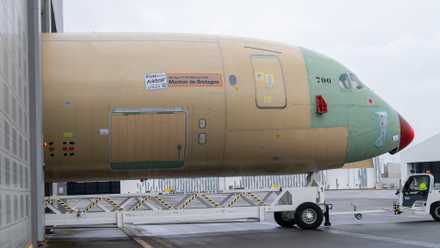
Airbus has notified select A350 customers of delivery delays stretching into the latter part of the decade, citing critical staffing shortfalls at its recently acquired facility in Kinston, North Carolina — formerly part of Spirit AeroSystems. The Kinston plant is responsible for manufacturing key A350 fuselage components and carbon-fiber wing spars, both of which are essential to the widebody's assembly timeline at Airbus's final assembly lines in Toulouse and Hamburg. The root cause of the staffing problem traces directly to the corporate restructuring of Spirit AeroSystems: when Boeing reacquired Spirit in 2025 to address its well-documented quality control failures, Airbus simultaneously purchased Spirit's facilities dedicated to Airbus component production. A significant number of Kinston employees subsequently migrated to Boeing-aligned ex-Spirit facilities, leaving Airbus with a depleted local workforce. To compensate, Airbus has deployed European personnel to the North Carolina plant, but the productivity gap created by workforce transition and cross-continental logistics has measurably slowed component output.
A separate and unrelated supply chain disruption at an Airbus facility in Spain is simultaneously affecting production of the A350F's main-deck cargo door — a structure that, at over 208 square feet, is designed to be the largest main-deck cargo door of any commercial freighter. Airbus had only recently celebrated the manufacture of the first such door, making any prolonged interruption particularly consequential for the certification and development schedule of the freighter variant. Airbus has stated publicly that the A350F's first flight, targeted for later in 2026, and initial deliveries planned for 2027 remain on schedule, though industry observers will monitor whether the Spain disruption persists long enough to erode that margin.
For airline operators and fleet planners, these delays compound an already strained capacity environment that has persisted since the post-pandemic recovery. Airlines that retired older, less fuel-efficient widebodies during the pandemic — expecting timely deliveries of new-generation replacements — continue to find themselves caught between growing passenger demand and constrained fleet growth. The A350 delays add to a widebody replacement backlog that already includes the long-deferred Boeing 777X, now not expected to enter service until 2027 at the earliest. Carriers that had structured network expansions or international route launches around specific A350 delivery windows will face renewed pressure to either extend leases on legacy equipment or seek wet-lease capacity in the interim.
For corporate and business aviation operators, the broader significance lies in what these cascading delays reveal about the structural fragility of aerospace supply chains following the Spirit AeroSystems breakup. The transfer of a major Tier 1 supplier's workforce between two competing OEMs — Boeing and Airbus — without adequate knowledge retention or transition planning represents a systemic risk that extends beyond any single aircraft program. Carbon-fiber composite structures like wing spars require highly specialized manufacturing expertise that cannot be rapidly replicated, making workforce continuity at facilities like Kinston disproportionately critical. The episode underscores why major aerospace programs remain vulnerable not merely to material shortages, but to the loss of institutional and technical human capital during corporate transactions.
The A350 delays also reinforce a pattern that has defined the post-pandemic aviation industry: OEMs announcing revised timelines with the expectation of further revision. Both Airbus and Boeing have repeatedly adjusted delivery forecasts across their narrowbody and widebody programs, including the A320neo family, the 737 MAX, and the Pratt & Whitney GTF-related groundings that affected hundreds of A320neo and A220 aircraft worldwide. Airlines and lessors have accordingly built greater schedule contingency into fleet planning, though that flexibility has limits as demand continues to outpace available capacity. For flight departments and operators evaluating fleet transitions or aircraft acquisitions in the widebody and large-cabin segment, these developments reinforce the prudence of maintaining conservative delivery assumptions and preserving optionality in fleet agreements.





 Read original article