Textron to separate Industrial to become pure-play aerospace, defence company | Corporate Jet Investor | CJI news
Textron Inc. announced on April 30, 2026, its intent to separate its Industrial segment from the rest of the corporation, repositioning the parent company as a pure-play aerospace and defense enterprise under the working designation "New Textron." CEO Lisa Atherton framed the move as a clarity-of-focus exercise, citing the fundamental divergence between aerospace and defense markets — which operate on long-cycle government contracts, specialized R&D pipelines, and deep regulatory environments — and the Industrial segment's shorter-cycle, consumer-facing businesses that include E-Z-GO golf carts, Jacobsen turf equipment, and Kautex automotive fuel systems. The Industrial segment generated approximately $3 billion in annualized 2026 revenue, roughly 21 percent of the company's total, and Textron is evaluating both an outright sale and a tax-free spin-off into a standalone publicly traded company. Completion is targeted within 12 to 18 months, with Goldman Sachs advising on the financial side and Latham & Watkins on the legal. Post-separation, New Textron would operate on a projected revenue base exceeding $12 billion, backed by a $19.2 billion backlog composed entirely of aerospace and defense work.
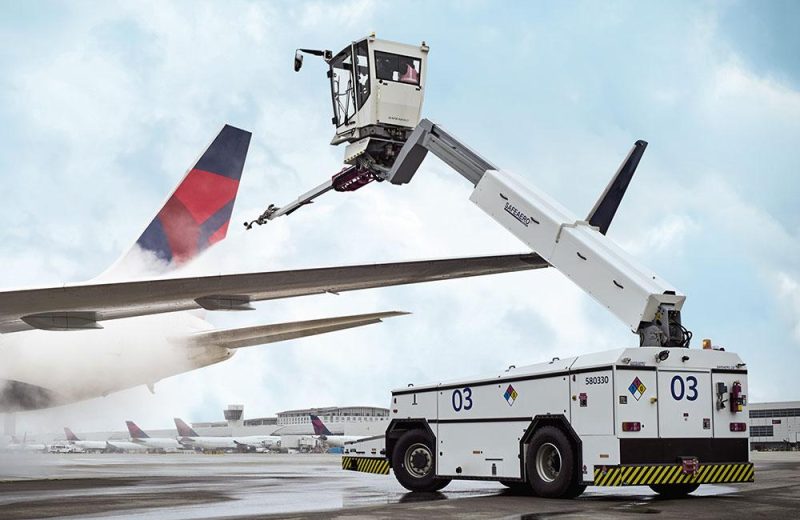
For pilots and aviation operators, the most operationally significant element of this restructuring involves ground support equipment. Textron's Industrial segment is the parent of Textron Specialized Vehicles, which markets airport ground support machinery under the TUG, Douglas, Premier, and Safeaero brands — pushback tractors, baggage tugs, belt loaders, deicers, ground power units, air starts, and AC units used across commercial ramps, FBOs, and Part 135 and 91K flightline operations worldwide. The separation of this business from the aerospace parent introduces procurement uncertainty for aviation operators who currently deal with a single conglomerate for both aircraft and ground equipment. Until the transaction closes, Textron has indicated the Industrial segment will continue operating under its current strategy, but operators managing multi-year GSE contracts or fleet refresh cycles should monitor the eventual disposition closely — a private equity buyer, for example, could alter pricing structures, parts availability timelines, or service network footprints in ways a captive corporate division would not.
The core of New Textron that matters directly to professional pilots is the company's retained Textron Aviation division, the world's largest manufacturer of general aviation aircraft under the Cessna and Beechcraft brands, and Bell Textron, which produces both military rotorcraft and commercial helicopters. Q1 2026 results showed robust demand across both divisions, with Aviation orders strengthening on continued momentum in the business jet and turboprop segments. Bell's military pipeline remains active, including the V-280 Valor tiltrotor under the Army's Future Long-Range Assault Aircraft program. Analysts at Vertical Research Partners noted that Textron's aerospace and defense divisions trade at a marked discount to sector peers — a 2027 price-to-earnings multiple of roughly 12x against a sector average near 25x — suggesting the market has long penalized the conglomerate structure. The separation is expected to compress that valuation gap as New Textron aligns with pure-play A&D comps.
The strategic logic mirrors a broader pattern of segment carve-outs across the defense industrial base, as conglomerates with mixed aerospace and non-aerospace holdings move to rationalize portfolios in response to investor pressure and the distinct capital demands of long-term government contracting. For Part 91 and Part 135 operators and their flight departments, the practical near-term implication is continuity — Cessna, Beechcraft, and Citation product lines remain under unified aerospace ownership, service networks are unaffected, and no aircraft model discontinuation or restructuring has been signaled. Longer term, a leaner, higher-margin Textron Aviation operating inside a focused A&D parent could accelerate investment in new platform development and avionics integration, particularly as business aviation demand continues to outpace pre-pandemic norms. The separation does not change the aircraft on the ramp today, but it sets the strategic conditions under which the next generation of Cessna and Beechcraft products will be developed and supported.