Jet Aviation launches drone-based AI aircraft inspections in the US | Corporate Jet Investor | CJI news
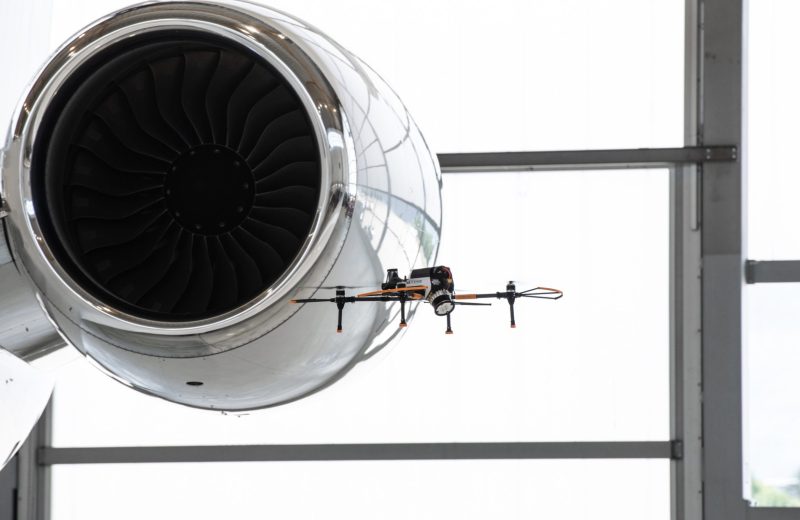
Jet Aviation has expanded its drone-based AI exterior inspection service to the United States, bringing technology first deployed at its Basel, Switzerland MRO hub in 2023 into the North American business aviation market. Developed in cooperation with AI drone specialist Donecle, the service uses automated drone flights to photograph nearly all external surfaces of an aircraft, with an AI system analyzing the imagery for anomalies that are then reviewed and confirmed by a trained human inspector. Findings are mapped onto a 3D model of the aircraft and compiled into a comprehensive digital report accessible to the customer, with the system also capable of comparing current results against historical inspections to flag new developments over time. The service is positioned for non-regulated inspections and is available either at Jet Aviation facilities or via dispatch of a trained technician to alternate locations, subject to local airport and hangar requirements.
For business jet owners, operators, and Part 91/135 flight departments, the most immediate application is in pre-purchase inspections, insurance assessments, and warranty documentation — areas where objective, timestamped exterior condition records carry significant legal and financial weight. Traditional PPIs rely heavily on the experience and availability of individual inspectors, introducing variability in thoroughness and documentation quality. A digitized, AI-assisted report mapped to a 3D aircraft model provides a defensible, impartial record of exterior condition at a specific moment in time, which can materially affect purchase negotiations, insurance claims, and warranty disputes. The ability to track condition changes between successive inspections also offers fleet managers and aircraft management companies a new tool for proactive maintenance planning and condition monitoring.
The Swiss Federal Office of Civil Aviation's 2024 approval of the technology for General Visual Inspections by images represents a meaningful regulatory milestone, establishing a precedent that drone-captured imagery can satisfy at least some formal inspection requirements under a national airworthiness framework. That approval does not yet extend to FAA-regulated inspections in the United States, and Jet Aviation is careful to characterize the current US offering as non-regulated — meaning these reports supplement rather than replace airworthiness inspections conducted under 14 CFR requirements. However, the regulatory pathway in Switzerland signals a trajectory that could eventually see AI-assisted drone inspections incorporated into FAA-accepted maintenance processes, particularly as the technology's accuracy improves through its built-in machine learning feedback loop, where inspectors continuously correct false positives to refine the model.
The scalability of the platform is notable for operators of less common or newer aircraft types. The three-step onboarding process — static scanning to create a 3D point cloud, programming the autonomous drone flight path, and validating against the physical aircraft — means that any fixed-wing or rotary-wing type can theoretically be added to the system without requiring Donecle or Jet Aviation to maintain a pre-existing digital model library. This lowers a key barrier to adoption across the diverse fleet composition typical of business aviation, where operators may be flying aircraft types ranging from legacy large-cabin jets to newer entrants like the Dassault Falcon 10X or Gulfstream G700. As AI inspection platforms mature and gain broader regulatory acceptance, MROs that build early operational experience with the technology will hold a competitive advantage in both turnaround efficiency and documentation quality — two factors that increasingly influence aircraft management and charter operator MRO selection decisions.