F-18 Fighter Jets Destroyed After Colliding Mid-Air Cost Nearly $70 Million Each, Navy Says
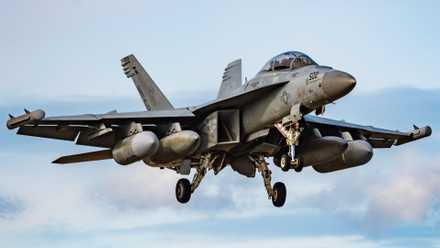
Two United States Navy EA-18G Growler electronic warfare aircraft were destroyed on May 17, 2026, following a midair collision during the "Gunfighter Skies" air show at Mountain Home Air Force Base in Idaho. Both jets, valued at approximately $68 million each according to the Navy, were assigned to Electronic Attack Squadron 129 out of Naval Air Station Whidbey Island, Washington. All four crew members — each aircraft carries a pilot and an electronic warfare officer — successfully ejected and survived the accident. The Navy confirmed a total loss of approximately $136 million in airframes alone, making the event one of the most financially significant non-combat aviation accidents in recent Navy history. Witness footage captured the aircraft making contact during a coordinated aerial demonstration at low altitude before both descended rapidly to the ground.
The EA-18G Growler is not a standard combat jet but a highly specialized derivative of the Boeing F/A-18F Super Hornet, having entered service in 2009 with a primary mission of electronic attack — jamming enemy radar, disrupting communications networks, and suppressing hostile air defenses. The aircraft is equipped with the AN/ALQ-218 receiver suite and ALQ-99 tactical jamming pods, and it retains air-to-air capability with AIM-120 AMRAAM missiles. Boeing has produced fewer than 200 Growlers for the U.S. Navy and allied operators, making the platform comparatively scarce. Because production rates have declined significantly, the loss of two airframes in a single incident cannot be remedied through rapid procurement; replacement would require congressional authorization and multi-year acquisition timelines, meaning operational capacity within electronic attack squadrons may be measurably reduced for years.
For professional pilots — particularly those operating in high-performance or formation-flight environments — the accident underscores the narrow margins present in close-proximity aerial demonstration flying. Air show profiles involving tight synchronized maneuvers, compressed lateral spacing, and rapid directional changes demand extraordinarily precise execution, and even minor deviations in timing, spacing, or control inputs can have catastrophic consequences at low altitude. The crew's survival in this case reflects the maturity of modern zero-zero ejection seat technology, which is designed to function at zero altitude and zero airspeed through explosive charges and rocket-assisted deployment. That all four crew members survived a low-altitude midair collision is a direct result of that engineering legacy, which has preserved thousands of military aircrew lives since its introduction.
The incident has reignited debate within defense and aviation circles about the appropriateness of deploying frontline, operationally critical aircraft in air show demonstration roles. Critics argue that the risk-to-benefit ratio is difficult to justify when the platforms involved are scarce, irreplaceable on short timelines, and laden with classified systems and mission-critical technology that extend their true value well beyond airframe cost. Supporters, including defense analysts cited in coverage of the accident, contend that such demonstrations serve meaningful recruiting and public trust functions. That tension is not unique to military aviation: civilian operators and regulatory bodies continuously assess similar tradeoffs between demonstration value, operational risk, and asset preservation across aerobatic, airshow, and test flight contexts.
The broader significance for aviation operators lies in what the accident illustrates about the compounding cost of modern aviation incidents. The $136 million figure cited by the Navy reflects only the replacement cost of two airframes and does not account for the loss of mission-ready electronic warfare capacity, the costs of investigation and corrective action, or the long-term implications for fleet readiness in a specialty aviation role that supports carrier strike group operations globally. As both military and civilian aircraft grow increasingly sophisticated — incorporating advanced avionics, encrypted data links, mission-specific software, and integrated sensor suites — the financial and operational consequences of accidents scale accordingly. Risk managers, safety officers, and operational leaders across commercial, business, and military aviation environments are watching incidents like the Mountain Home collision as a reference point for how institutional risk tolerance must evolve alongside aircraft complexity and cost.








 Read original article