Newsroom
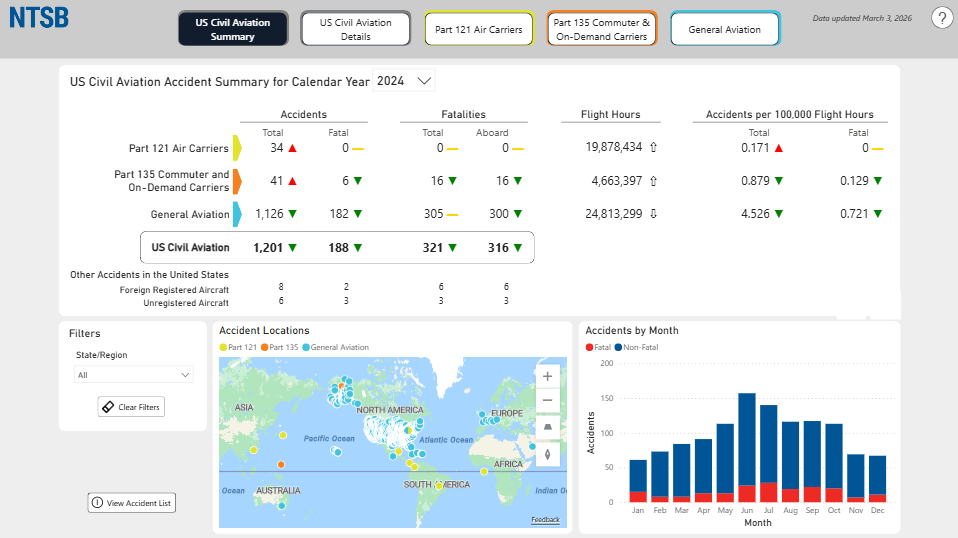
The National Transportation Safety Board's recent activity reflects a significant shift toward data transparency and proactive safety communication, most notably through the May 4, 2026 enhancement of its U.S. Civil Aviation Accident Dashboard. The agency has integrated findings data directly into the dashboard while simultaneously retiring the standalone General Aviation Dashboard, consolidating accident analysis into a single, more comprehensive tool. This structural change means that investigators, operators, safety managers, and flight departments can now access causal and contributing findings alongside raw accident statistics in one interface, rather than cross-referencing separate platforms. The retirement of the dedicated GA dashboard does not signal diminished attention to general aviation accidents — rather, it reflects a deliberate move toward unified data architecture that allows for broader comparative analysis across aviation sectors.
The NTSB's scheduled two-day investigative hearing on May 19–20 concerning a November 2025 UPS cargo crash represents one of the agency's most significant ongoing aviation investigations. Public investigative hearings of this format are reserved for accidents of substantial complexity or systemic importance, typically involving questions of airworthiness, crew performance, air traffic control, or operating procedures that carry industry-wide implications. While full findings have not yet been released, the hearing format signals that the NTSB believes the circumstances of the UPS crash warrant formal examination of evidence and witness testimony in a structured, transparent setting. Cargo operators flying under Part 121 and Part 135, as well as freight departments within corporate flight operations, should monitor the hearing's outputs closely, as NTSB probable cause determinations and safety recommendations from cargo accidents frequently generate corresponding FAA action and operator guidance.
The agency's March 31 findings on automation overreliance in two fatal Ford BlueCruise crashes carry direct and unmistakable relevance to professional aviation, even though the subject vehicles are ground-based. The NTSB concluded that drivers fatally over-trusted a partial automation system — one not designed to replace active human monitoring — and that standardized performance requirements and stronger oversight frameworks are needed across the partial-automation sector. Aviation professionals will recognize this hazard taxonomy immediately: mode confusion, automation complacency, and the degradation of manual proficiency are documented threats in advanced glass-cockpit environments, TCAS/ACAS operations, autoflight systems, and increasingly in advanced air mobility platforms entering certification. The NTSB's willingness to issue systemic recommendations on automation design standards based on automotive accidents signals that the agency views over-reliance on partial automation as a cross-modal safety crisis, not an isolated automotive problem.
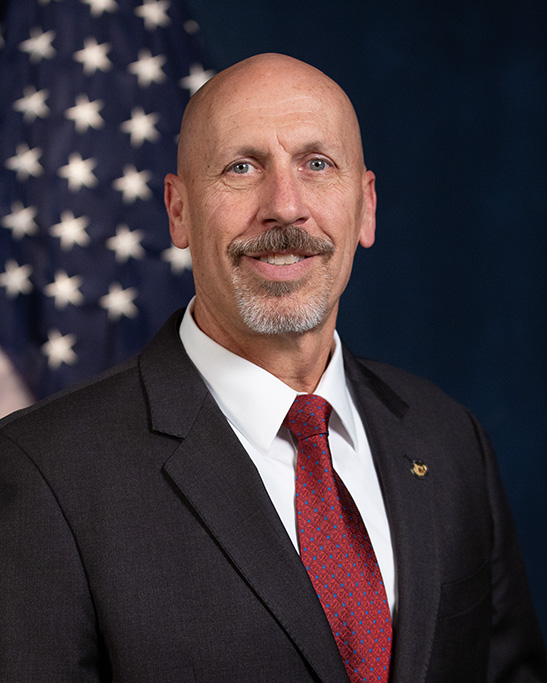
The appointment of Michael Graham as NTSB Vice Chairman by President Trump also carries procedural significance for aviation operators tracking how the agency will prioritize its investigative and regulatory agenda in the near term. Graham's elevation, effective April 3, 2026, positions him as the agency's second-ranking official and a key architect of its rulemaking recommendations to the FAA and DOT. Leadership transitions at the NTSB can influence which accident categories receive accelerated investigation timelines, which safety recommendations are forwarded to Congress, and how the agency engages with industry stakeholders on emerging technology questions — including those surrounding automation, urban air mobility, and advanced avionics. For chief pilots, directors of operations, and safety officers across Part 91, 91K, 121, and 135 environments, maintaining awareness of NTSB leadership and its evolving data tools is not administrative housekeeping; it is foundational to anticipating the regulatory and operational guidance that will define near-term compliance obligations.


.png)

 Read original article