United 777 Diverts To Amsterdam, Then Newark In Rare 24-Hour Double Diversion Flight
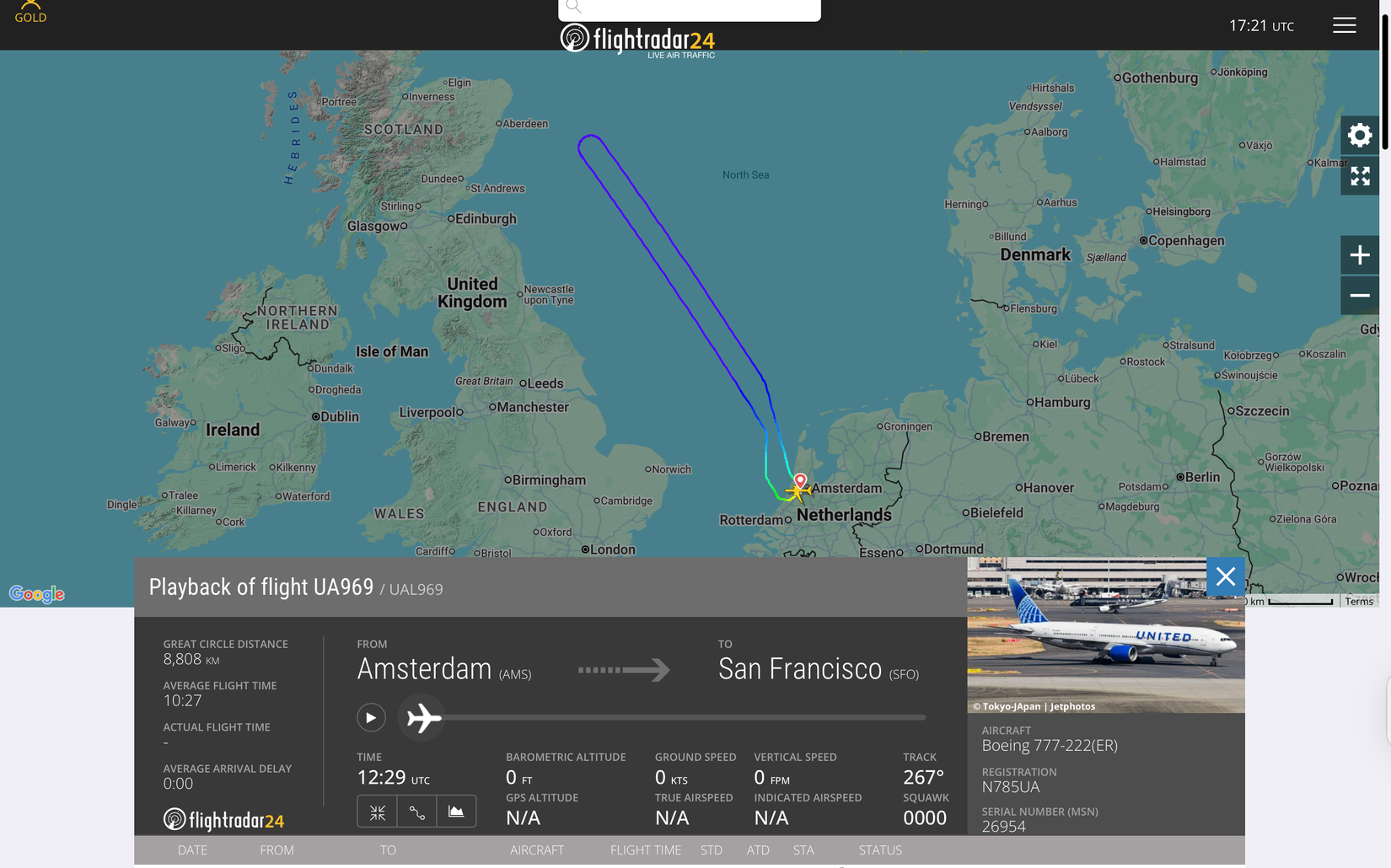
United Airlines flight UA969, operating aboard Boeing 777-200ER N785UA, became the subject of widespread attention in aviation tracking communities after experiencing two separate diversions during a single transatlantic attempt on May 24–25, 2026. The aircraft departed Amsterdam Schiphol at approximately 3:00 PM local time bound for San Francisco but turned back over the North Sea less than an hour into the flight, circling for nearly two hours before landing safely at Schiphol. After maintenance inspections and a delay of more than four hours, the same airframe departed again at approximately 6:50 PM local time. That second attempt successfully crossed the Atlantic but ultimately diverted to Newark Liberty International before the crew eventually continued to San Francisco, arriving in California around 1:30 AM on May 25 — nearly 24 hours after the original scheduled departure. United has not publicly disclosed the technical cause of either diversion.
For professional crews operating long-haul international routes, the operational logic of the first diversion is straightforward and consistent with standard practice. Returning to a hub-quality international airport like Schiphol within the first hour of a transatlantic departure is the operationally sound choice — full maintenance infrastructure, certified parts, relief crews, and regulatory support are all available on the ground. The more operationally significant event is the second diversion. After a maintenance review cleared the aircraft for another attempt and the crew accepted the release, the flight still failed to complete the transatlantic sector nonstop. The second diversion to Newark — a major domestic hub for United with ample technical support — rather than continuing to San Francisco suggests a second anomaly emerged in flight, possibly a recurrence of a related system fault or an entirely separate issue. The fact that United did not swap to a different airframe between attempts will likely be a point of scrutiny in any subsequent review.
The aircraft at the center of this event, N785UA, is approximately 29 years old, placing it among the oldest 777-200ERs in United's active long-haul fleet. Aircraft of this age operating high-cycle, high-hour international routes face cumulative wear on avionics, hydraulic systems, pressurization, and engine components that newer frames do not. While age alone does not indicate unreliability — properly maintained legacy airframes regularly complete heavy international operations without incident — the coincidence of two in-flight anomalies on the same aging jet within the same 24-hour window raises questions about whether the initial maintenance evaluation fully resolved or identified the underlying fault. For operators and fleet managers, this incident illustrates the risk of returning an older airframe to long-haul service following an unplanned maintenance event without achieving a confirmed, root-cause resolution.
From a broader industry perspective, the incident highlights a tension that large network carriers increasingly face as they manage aging widebody fleets against route demand and limited spare aircraft availability. The 777-200ER was state-of-the-art technology when N785UA was delivered in the late 1990s, but many operators have been systematically retiring these frames in favor of 787-9s, 787-10s, and 777-9s, with some older 777s being converted to freighters rather than maintained in passenger service. United's continued operation of high-hour -200ERs on transatlantic routes reflects both the residual capacity demand on routes like AMS-SFO and the realities of widebody availability, particularly amid ongoing Boeing delivery delays. For Part 91K and 135 operators flying aging business jets on transatlantic and international routes, the same principle applies — when an in-flight anomaly forces a return to the departure airport, the decision to release the same airframe for a subsequent attempt should be grounded in a confirmed, documented root-cause resolution, not merely the absence of an active fault indication on the ground.










 Read original article