A Forest Fire at Sea – the USS Forrestal
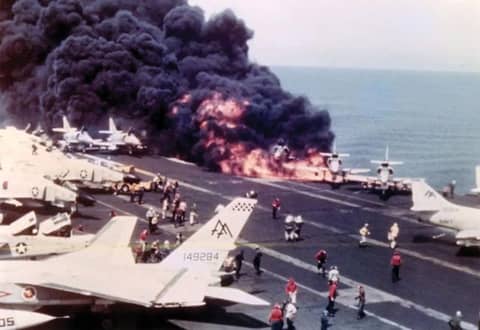
The USS Forrestal fire of July 29, 1967 stands as one of the most consequential disasters in naval aviation history, and its lessons continue to shape the safety culture that governs flight operations across every segment of aviation. The catastrophe began at approximately 10:52 AM on Yankee Station in the Gulf of Tonkin when an inadvertent electrical surge discharged a 5-inch Zuni rocket from an F-4B Phantom, striking a parked A-4E Skyhawk and rupturing its fuel tank. Roughly 40,000 gallons of JP-5 erupted across the aft flight deck — a fully armed, high-density combat launch environment — and within 96 seconds the first thousand-pound bomb cooked off, killing 35 sailors instantly. By the time the fire was declared out 17 hours later, 134 crew members were dead, 161 injured, 21 aircraft destroyed, and the ship had sustained structural damage that required a $195 million rebuild. John McCain, then a 30-year-old lieutenant commander, was among the wounded, surviving by scrambling across wing surfaces as the deck exploded around him.
For professional pilots and aviation operators, the Forrestal disaster is not merely a piece of naval history — it is a foundational case study in the compounding nature of systems failures during high-tempo operations. The initiating cause was electrical: a voltage spike from an improper power transfer, transmitted through a degraded pylon connector weakened by chafing and saltwater exposure, energized a weapon that had no business firing. The chain of consequences that followed — inadequate initial suppression due to undertrained hose teams using seawater on a Class B fuel fire, the delay in deploying AFFF foam, the proximity of armed ordnance to burning fuel — illustrated precisely how a single electrical anomaly in a complex operational environment can cascade beyond any single crew's ability to contain it. These dynamics are not unique to naval aviation: every flight operation involving fuel, pressurized systems, and electrical architecture carries latent risk amplified by procedural shortcuts, deferred maintenance, and high sortie pressure.
The Forrestal fire accelerated a wholesale reformation of carrier aviation safety protocols that eventually permeated the broader aviation industry. The Navy's investigation identified no single individual for court-martial — a recognition that systemic failures, not individual negligence, had created the conditions for catastrophe. The Zuni rocket's electrical vulnerability was addressed through rewiring standards; hot arming procedures were codified; flight deck spacing requirements were tightened; and damage control training was fundamentally restructured across the fleet. The 1966 USS Oriskany fire (44 dead) and the 1969 USS Enterprise fire (28 dead) framed the Forrestal event as part of a pattern demanding institutional, not just procedural, correction. This systems-level response — investigating root cause rather than proximate blame — mirrors the methodology that the NTSB would later apply to commercial and general aviation accident investigations, and which underpins the voluntary safety reporting culture enshrined in NASA's Aviation Safety Reporting System.
The Airplane Geeks' account of the Forrestal, framed through Micah Engber's Veteran's Day encounter with a survivor, underscores a parallel reality in aviation: the institutional memory of catastrophic events depends heavily on the living testimony of those who were present. The unnamed veteran — a teenager during the fire, now in his late seventies — declined to be interviewed, a response that speaks to the psychological weight carried by those who witnessed large-scale loss of life in an operational aviation environment. For working pilots, particularly those in high-tempo operations such as charter, air medical, agricultural, or military aviation, the Forrestal remains a reminder that flight deck discipline — the enforcement of checklists, safety interlocks, arming protocols, and crew resource management — is not bureaucratic friction but the structural barrier between normal operations and unrecoverable catastrophe.
The USS Forrestal herself was eventually decommissioned in 1993 after serving as a training carrier, having never returned to combat following the 1967 fire. Her legacy endures not in operational deployments but in the safety infrastructure that governs modern naval and civil aviation. The supercarrier concept she pioneered — the angled flight deck, optical landing system, and steam catapult, all incorporated by design rather than retrofit — reflected the same engineering philosophy that distinguishes purpose-built safety architecture from after-the-fact workaround. That philosophy, whether applied to carrier aviation, transport category aircraft, or business jet operations, remains the clearest line between a manageable incident and an uncontrollable disaster.


 Read original article