The C‑17 Globemaster’s Unique Cabin Design That Enables Massive Airlift Capability
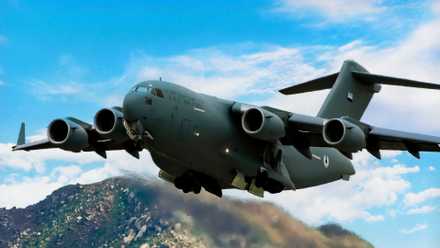
The Boeing C-17 Globemaster III occupies a singular position in global airlift operations by bridging the tactical and strategic transport roles that previously required separate aircraft fleets. Entering USAF service in 1995 after development in the late 1980s, the aircraft was engineered to fill the operational gap between the turboprop C-130 Hercules and the larger C-5 Galaxy, combining the C-5's intercontinental reach with the C-130's ability to operate from austere, short-field environments. Its cargo compartment — approximately 88 feet long, 18 feet wide, and over 12 feet high — accommodates up to 18 standard 463L pallets or outsized loads including M1 Abrams main battle tanks, Bradley fighting vehicles, and rotary-wing aircraft. Critically, the aircraft's low-profile landing gear and integrated roll-on/roll-off ramp system eliminate dependence on fixed ground infrastructure, allowing full combat-load operations from unprepared strips as short as 3,000 feet. This performance envelope is not theoretical; it has been validated repeatedly in combat logistics operations across Afghanistan, Iraq, and beyond.
For aircrew and operators working in military airlift, special operations support, or contracted logistics roles, the C-17's cabin architecture directly shapes crew workload and mission planning calculus. The integrated floor roller system and tie-down points rated for extreme vehicle weights demand precise weight-and-balance management and load planning discipline, particularly when reconfiguring between cargo, aeromedical evacuation, and troop-transport roles. The aircraft's aeromedical evacuation configuration, which converts the cargo bay to carry up to 74 patients — 36 on litters and 54 ambulatory — along with attending medical personnel and powered medical equipment, represents one of the more demanding cabin management scenarios in transport aviation. Crews executing AE missions must coordinate oxygen system management, power distribution to medical devices, and patient movement procedures while maintaining standard flight operations, a workload profile that requires both medical crew integration and thorough pre-mission configuration verification.
The C-17's demonstrated performance during the COVID-19 pandemic underscores a broader operational reality that aviation professionals across sectors increasingly encounter: the expectation that heavy transport platforms will be rapidly repurposed across mission types with minimal ground time. During the pandemic, USAF and Royal Air Force C-17 fleets moved medical supplies, deployed field hospital units, and evacuated infected personnel across intercontinental routes as commercial aviation infrastructure collapsed. This mirrors the pattern established during the 2010 Haiti earthquake response and Middle East casualty evacuation operations, where the aircraft transitioned from bulk cargo to flying intensive-care-unit configurations within hours of landing. For operators and logistics planners, this adaptability is not incidental — it is a deliberate design outcome, reflecting a philosophy that platform value is measured not just in payload capacity but in reconfiguration speed and operational flexibility across dissimilar mission sets.
Within the broader context of military and heavy-lift commercial aviation, the C-17 represents a design philosophy that civilian large-aircraft operators are beginning to examine more seriously. The emphasis on austere-field capability, rapid reconfiguration, and modular interior systems has influenced thinking around next-generation transport aircraft concepts in both military and commercial contexts. The comparison with the C-5 Galaxy — which retains payload and range advantages but lacks the C-17's short-field agility — illustrates the persistent tension between raw capacity and operational versatility that frames procurement decisions across aviation sectors. As fleet aging accelerates and no direct C-17 replacement program has entered full development, air mobility planners face a structural challenge: the combination of strategic reach, tactical agility, and multi-mission cabin adaptability the C-17 delivers has proven extraordinarily difficult to replicate in a single airframe, a fact that continues to shape both military airlift doctrine and the aircraft's operational longevity well into the late 2020s.








 Read original article