Opinion Archives : Air Facts Journal
Air Facts Journal's opinion archives from early 2026 reflect a publication focused squarely on the practical and philosophical dimensions of general aviation, with recurring themes of skill maintenance, safety discipline, and the evolving identity of the GA community. The collection spans firsthand operational accounts, formal safety guidance, and broader advocacy commentary, drawing from contributors ranging from aerobatic instructors to volunteer humanitarian pilots. Taken together, the pieces constitute a cross-section of concerns that resonate well beyond the recreational flying segment, touching on issues directly relevant to pilots operating under Part 91, 135, and professional training pipelines.
Operational currency and precision skill-building emerge as persistent threads. Serrhel Adams's "Thirty Minutes" makes the case that a disciplined 30-to-45-minute local flight—executed with intention across stall series, slow flight, and aerobatic sequences—delivers training value disproportionate to its Hobbs time. This argument matters to professional pilots who face recurrent training requirements and often struggle to integrate meaningful stick-and-rudder practice into high-utilization schedules. Bob Whelan's "$100 Hamburger Reflections" extends this reasoning, framing discretionary flying not as recreation but as a structured exercise in maintaining cognitive engagement with autopilot systems, en-route weather interpretation, and precision navigation—skills that atrophy in absence. Both pieces implicitly challenge the tendency to conflate regulatory currency with genuine proficiency, a distinction that surfaces repeatedly in accident analysis and recurrent training doctrine.
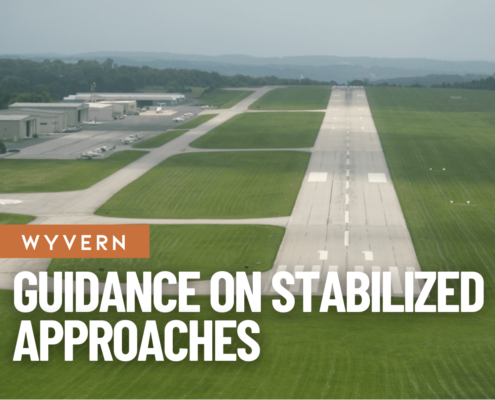
The WYVERN guidance piece on stabilized approaches, published under the Air Facts Staff byline, addresses one of the more persistent gaps in operational airmanship. Runway excursions remain a leading accident category across all segments of aviation, and the piece identifies the core problem as a knowledge-behavior disconnect: pilots broadly understand stabilized approach criteria and defined gates but fail to act on them consistently. This framing aligns with FAA and CAST research that has shifted accident prevention focus from procedural gaps to human factors and organizational culture. For Part 135 operators and corporate flight departments operating under safety management systems, the WYVERN document offers external validation for internal go-around culture reinforcement—an area where crew resource management programs often struggle to translate policy into habit.
Chris Schaich's "Flying for Life" account of a blood delivery mission across Arizona adds humanitarian operational context to the archive, illustrating the tangible public benefit of maintaining a trained and active GA pilot workforce. Volunteer pilot organizations such as Angel Flight and Pilots N Paws operate under Part 91 frameworks that rely on pilots who sustain genuine proficiency rather than minimum-currency compliance. Alexander Sack's "Whose Freedom To Fly Is It Anyway?" situates these individual stories within a broader governance debate, noting that AOPA's perceived disconnect from the working GA community raises fundamental questions about how heterogeneous constituencies—recreational pilots, commercial operators, aerobatic competitors, and humanitarian fliers—should be collectively represented. The tension Sack identifies is not new, but the moment is notable given AOPA's role in regulatory advocacy affecting everything from MOSAIC rule implementation to airspace access policy that directly shapes Part 91 operational flexibility.
Across the full opinion archive, Air Facts Journal continues to function as a practitioner-level forum where firsthand operational experience informs safety culture rather than responding to it. The breadth of voices—aerobatic instructors, air racers, humanitarian mission pilots, career aviators—reflects a GA community whose common denominator is not aircraft type or operational certificate but a shared ethic of continuous skill development. For professional and corporate pilots, the archive's value lies less in any single article than in its cumulative argument: that disciplined flying, whether conducted in a Cub at 1,000 feet AGL over the Dallas–Fort Worth Metroplex or in a business jet on a stabilized ILS approach, demands the same quality of intentional decision-making that separates competent from genuinely proficient airmanship.

















 Read original article