New: Phoenix To Become STARLUX Airlines’ 1st Airbus A350-1000 Long-Haul Destination
STARLUX Airlines will begin operating its Airbus A350-1000 on the Taipei Taoyuan–Phoenix Sky Harbor route effective July 2, 2026, marking the carrier's first deployment of the larger variant on a long-haul transpacific segment. The upgrade replaces the A350-900, which seats 306 passengers, with the A350-1000's 350-seat configuration spanning four cabin classes: four first-class suites with Zero Gravity recline capability, 40 business class seats, 36 premium economy, and 270 economy. The service operates four times weekly in each direction, with the westbound JX026 departing Phoenix at 11:55 PM and arriving Taipei at 4:55 AM, and the eastbound JX025 departing Taipei at 8:10 PM and arriving Phoenix at 6:10 PM. STARLUX currently operates only two A350-1000 airframes, with 16 additional units on order, making Phoenix a significant testbed for the airline's long-haul expansion strategy using the type.
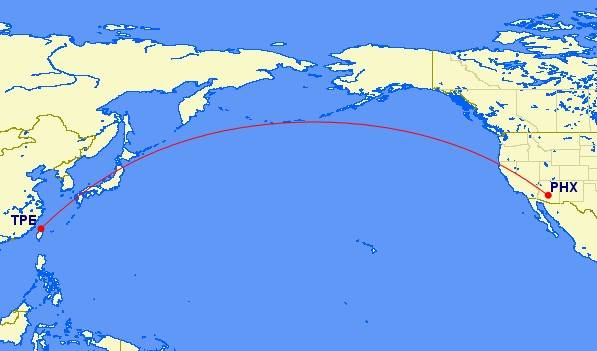
For aviation professionals and operators, the Phoenix upgrade signals continued growth of ultra-long-haul widebody traffic into Sky Harbor, a reliever airport that has increasingly attracted international carriers looking to avoid congestion at Los Angeles International. PHX's positioning as a transpacific gateway is notable given its infrastructure capacity and connecting demographics across the southwestern United States. Pilots and dispatchers operating in and out of PHX should anticipate heavier widebody movements on the Tuesday, Thursday, Saturday, and Sunday schedule, with the late-night departure westbound requiring careful coordination around overnight ground operations and fuel planning for the approximately 13-14 hour sector. The A350-1000's extended range and fuel efficiency over the A350-900 makes it operationally well-suited for the roughly 6,800-nautical-mile TPE-PHX routing, which transits North Pacific oceanic tracks and MNPS/RVSM airspace.
STARLUX's fleet buildout tells a broader story of aggressive capacity scaling by a carrier that only commenced operations in January 2020 and launched US service as recently as April 2023. The airline now operates to four US points—Los Angeles, San Francisco, Ontario, and Phoenix—all on a year-round basis, a remarkably fast transpacific footprint for a carrier under seven years old. With 16 A350-1000s on order and 10 A350F freighters slated for delivery from 2028, the airline is clearly positioning itself not only as a premium passenger carrier but as a future transpacific cargo competitor, which has implications for belly freight capacity and charter cargo availability on these corridors.
The 2027 route expansion announcements—Barcelona, Zurich, Sydney, and Auckland—underscore the carrier's intent to build a genuine hub-and-spoke long-haul network radiating from Taipei Taoyuan, a strategy that will require continued heavy reliance on A350-1000 airlift. The Sydney service with a tag-on to Auckland introduces STARLUX into a market dominated by China Airlines and EVA Air, while the European routes to Barcelona and Zurich will open without direct Taiwanese carrier competition, offering potentially strong yield environments. For corporate flight departments and Part 135 operators managing international routing and connections, the maturation of STARLUX's network adds a credible alternative carrier option on transpacific and eventually trans-European routings through Taipei, particularly relevant for travelers in markets like Phoenix and Ontario that have historically had limited nonstop long-haul options.
The broader industry context is one in which second-tier full-service Asian carriers—unburdened by legacy fleet complexity and focused on premium product differentiation—are challenging the established order on transpacific routes. STARLUX's founding under a pilot-CEO, its rapid transition to widebody operations, and its deliberate cabin product investment reflect a model that competes on service quality rather than price, directly targeting the premium business travel segment that corporate aviation departments track closely. As the A350-1000 order book delivers over the next several years, STARLUX's operational profile will increasingly resemble that of a mid-sized global network carrier, with crew training, maintenance infrastructure, and dispatch complexity to match.











 Read original article