Flight Deck | Aviation Week Network
Aviation Week Network's Flight Deck section has tracked a concentrated period of product launches, infrastructure investment, and training innovation across the first quarter of 2026, reflecting an industry simultaneously managing a pilot supply constraint and an accelerating cockpit automation cycle. The most prominent hardware developments center on Cirrus Aircraft, which unveiled both its G3 Vision Jet in February and the 2026 SR Series G7+ piston line in January. The G3 Vision Jet represents the third generational iteration of the world's best-selling personal jet and introduces upgrades to avionics integration, cabin systems, and the Cirrus Airframe Parachute System envelope, while the G7+ SR Series brings refinements to the SR20, SR22, and SR22T platforms that collectively dominate owner-flown piston training pipelines. Dassault Aviation's Falcon 10X flight deck, examined in a March feature, adds to the narrative of large-cabin bizjet automation, with pilot assistance features specifically engineered to reduce crew workload through a four-large-display architecture and enhanced synthetic vision and heads-up display capability—positioning the aircraft competitively against Gulfstream's G700 in the ultra-long-range segment.
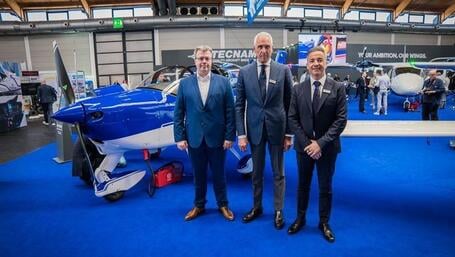
On the training and workforce side, Cirrus announced in April an expansion of its training ecosystem with increased simulator integration, a direct acknowledgment that the persistent bottleneck in general aviation is not aircraft availability but qualified pilot throughput. This mirrors a broader industry pattern in which OEMs are absorbing training infrastructure responsibilities previously left to independent flight schools and FBOs. Embry-Riddle Aeronautical University's collaboration with Navi AI, reported in February, takes a complementary approach by deploying AI-generated feedback tools to reinforce and personalize flight instructor lessons—a development with practical implications for standardization of instruction quality across both university and Part 141 environments. The Tecnam order activity at Aero Friedrichshafen in late April, with Greybird Aviation and AirTaxi Express among buyers, signals continued institutional demand for purpose-built ab initio trainers as regional and charter operators seek to establish or expand their own pipeline programs rather than rely on an increasingly constrained external supply.
Garmin's acquisition of a hangar and office complex at Mesa Gateway Airport in February deserves particular attention from operators and avionics professionals tracking the certification landscape. The expansion of Garmin's aircraft certification and flight-test capacity directly affects the pace at which new avionics products—including software-defined panel systems and retrofit upgrades—can move through FAA certification. For Part 135 and Part 91K operators managing scheduled avionics upgrade cycles or evaluating next-generation integrated flight decks, Garmin's physical infrastructure investment suggests the company is positioning for a sustained product development tempo, likely tied to the growing installed base of G3000 and G5000 suites across turboprop and light jet fleets. Elliott Aviation CEO Michael Parrish's April interview, covering market demand, first-time buyers, and merger-and-acquisition activity, provides complementary context: MRO and completion center consolidation is continuing, and the entry of first-time buyers into the business aviation market is sustaining demand for both new aircraft sales and aftermarket support services.
Taken together, the Flight Deck coverage from late 2025 through early 2026 reveals a sector in which the automation-versus-workforce tension is being addressed on multiple fronts simultaneously. OEMs are building automation features into new designs to offset crew workload and reduce training time to type proficiency, while independently investing in the training infrastructure to produce the pilots those aircraft require. The AI-assisted instruction tools emerging from academic partnerships represent an early but meaningful step toward scalable, data-informed training quality management—a capability that Part 135 operators and flight departments under IS-BAO or NBAA safety program frameworks may eventually integrate into recurrent training audits. For working pilots across airline, business aviation, and general aviation segments, the near-term practical takeaway is that cockpit complexity is increasing faster than traditional ground-school and sim curricula are adapting, making early familiarity with next-generation avionics suites and AI-augmented training tools a meaningful professional differentiator.






 Read original article