Why Delta Air Lines Isn't Betting Its Long-Haul Future With Airbus Entirely
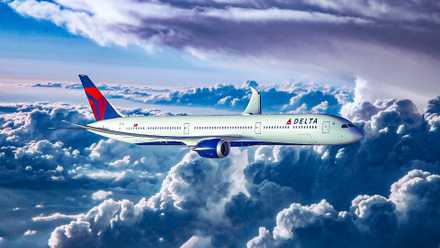
Delta Air Lines' January 2026 order for 30 Boeing 787-10s with 30 options marks a significant strategic pivot for a carrier that has leaned heavily on Airbus for its widebody fleet over the past decade. The order complements Delta's existing commitments to the A330-900neo and A350 family, creating a three-type widebody strategy designed to address a cascade of fleet replacement needs while simultaneously enabling network upgauging. The 787-10, the longest-range variant of the Dreamliner family and notably larger than the 787-8 or 787-9, will allow Delta to densify transatlantic A330-900 routes while freeing A350-900s — with their superior range — to push deeper into Pacific expansion. This is a deliberate, tiered approach: the A330-900 absorbs the 767-300ER replacement role, the 787-10 handles upgauging and mid-range transoceanic growth, and the A350 anchors the longest-haul operations.
The fleet arithmetic behind this strategy is particularly relevant to aviation operators tracking capacity trends. Delta currently operates 21 Boeing 767-400ERs, 11 A330-200s, and 21 older A330-300s, all of which will require replacement through the 2030s. The 767-400ERs, which received cabin refurbishments in 2019, are the likely first candidates for retirement, while the A330-200s and older A330-300s are set to receive new interiors beginning in 2027 — a stopgap that buys time before replacement rather than a long-term commitment. The combination of 30 firm 787-10s, 30 787 options, and 20 flexible Airbus widebody options gives Delta the optionality to retire all three legacy fleets on an accelerated or conservative timeline depending on demand conditions. This kind of structured optionality is increasingly standard practice among major carriers managing long-cycle aircraft programs against unpredictable demand environments.
The dual-sourcing dimension of this order carries meaningful implications beyond Delta's own network. Maintaining active purchase relationships with both Airbus and Boeing gives Delta negotiating leverage on pricing, delivery slots, and contractual terms in a market where delivery queues are historically congested. Delta's ability to absorb up to 60 787s makes it a tier-one Boeing customer, and Boeing — working to rebuild commercial credibility and order momentum — would have had strong incentive to offer competitive delivery positions and pricing to secure the deal. For airlines and corporate flight departments watching OEM relationships closely, Delta's move illustrates that even carriers with a clear manufacturer preference can extract significant commercial advantage by keeping both production pipelines open, particularly during periods when one manufacturer is experiencing production constraints or certification delays.
The Delta TechOps dimension of this order is often underappreciated in fleet strategy analysis but is directly material to the economics of the deal. Delta TechOps, one of the largest third-party MRO operations in the world, secured overhaul certification for the GEnx engine — which powers the 787-10 — as part of the broader transaction. Combined with its existing Trent 1000, Trent 7000, and Trent XWB overhaul capabilities, Delta TechOps will now be positioned to service powerplants across nearly every major widebody program currently in service globally. This transforms aircraft procurement into a revenue-generating infrastructure decision rather than a pure cost event, a model that few airlines execute at Delta's scale. For operators and maintenance professionals, it underscores the degree to which large integrated carriers blur the line between airline and aerospace service company.
Viewed against the broader widebody market, Delta's strategy reflects an industry-wide trend toward fleet simplification and upgauging that accelerated in the post-pandemic capacity recovery. The retirement of 767-300ERs — workhorses of the transatlantic market for decades — in favor of A330-900s represents a meaningful step-up in seat capacity and passenger experience standards on routes that were long served by aging, narrower-cabin widebodies. As Delta and its network peers continue to pursue premium cabin densification and long-haul frequency growth, the competitive pressure on routes across the Atlantic and Pacific will intensify. Pilots operating international widebody equipment should anticipate continued investment in new-generation aircraft with advanced avionics, revised automation philosophies, and updated EFB and connectivity infrastructure — all of which carry recurrent training and type qualification implications that fleet planning decisions at this scale ultimately drive downstream.










 Read original article