In Photos: Onboard Air Canada's Brand New Airbus A321XLR
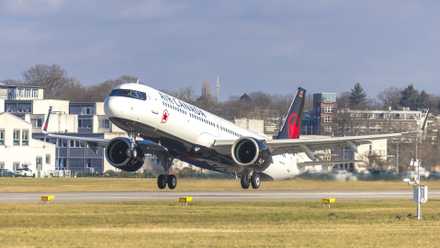
Air Canada became the first Canadian operator of the Airbus A321XLR when it accepted delivery of tail number C-GXLR on April 24, 2026, in Hamburg, Germany. The airline has committed to a fleet of 30 aircraft — 15 leased from SMBC Aviation Capital and 15 purchased directly from Airbus — with options for ten additional frames that could bring the total to 40. All examples are powered by Pratt & Whitney PW1100G geared turbofan engines, which, combined with an advanced aerodynamic package and composite airframe construction, deliver a 30% reduction in fuel burn relative to prior-generation narrowbodies and extend usable range to 4,700 nautical miles. The inaugural revenue service will connect Montréal-Trudeau to Palma de Mallorca beginning in June, with further Atlantic and transcontinental routes from Toronto planned to follow in short order.
From an operational and financial planning standpoint, the A321XLR addresses a structural problem that has long shaped how network carriers approach thin transatlantic routes. Air Canada's Boeing 787-8 seats 255 passengers and the 787-9 seats 298, configurations that demand near-capacity loads to generate acceptable unit economics on lower-demand city pairs or seasonal leisure markets. The XLR's 182-seat layout — 14 Signature Class lie-flat seats and 168 economy — dramatically lowers the revenue threshold required to turn a profitable flight. This right-sizing logic is central to the aircraft's commercial case: carriers can now justify year-round or seasonal service to secondary European leisure destinations without committing widebody economics to variable demand cycles. The risk exposure per departure is materially lower, which allows scheduling teams to add or suspend frequencies with far less financial consequence than they face with twin-aisle assets.
For pilots transitioning to or operating the type, several systems-level characteristics distinguish the XLR from legacy A321 variants. The addition of the Rear Center Tank is the most operationally significant change, as it increases total fuel capacity to support the extended range mission and introduces additional fuel management considerations not present on the ceo or prior neo variants. The PW1100G GTF powerplant, common across the A320neo family, brings its established single-lever power management paradigm and advanced FADEC logic, but pilots should remain current on the specific engine health monitoring practices associated with the GTF given the fleet's relatively recent service history and the attention its early-service reliability record drew from operators worldwide. Crew resource management on long-duration narrowbody sectors — potentially approaching ten hours — will also require deliberate fatigue management planning, as duty periods on these routes push up against the physiological limits more typically associated with widebody operations but without the crew augmentation provisions common on long-haul twin-aisle aircraft.
The broader industry significance of the A321XLR's entry into North American service extends well beyond Air Canada's specific network strategy. The aircraft validates a thesis that Airbus, Pratt & Whitney, and lessors like SMBC have been advancing for years: that narrowbody economics can be extended into mission profiles previously reserved for widebodies, fundamentally reshaping point-to-point route economics across the North Atlantic and potentially the Pacific. Competing operators — including United Airlines, which has also taken delivery of the type — will use the XLR to contest hub-bypass routes that legacy carriers have historically served only with larger and costlier equipment. For charter, ACMI, and Part 135 operators in the business aviation adjacent space, the XLR's cabin technology advances — particularly the active humidity management, 2-to-3 minute full air renewal cycle, enhanced acoustic insulation, and widebody-derived overhead architecture — set a new passenger experience benchmark that will increasingly influence client expectations on long-range charter missions flown on purpose-built business jets and large-cabin aircraft.
The A321XLR's market entry also arrives at a moment when aircraft availability constraints, persistent supply chain delays from both Airbus and Boeing, and elevated financing costs are forcing fleet planners to make unusually long-horizon commitment decisions. Air Canada's lease structure through SMBC for half of its initial order reflects a calculated hedge, preserving balance sheet flexibility while securing early delivery positions on one of the most heavily backlogged narrowbody variants in the current cycle. For operators monitoring the used aircraft and lease market, the XLR's entry into service with major network carriers will gradually expand the secondary availability pool, though meaningful lease return activity on this specific variant remains years away given the recency of deliveries and the depth of outstanding orders across the global order book.








 Read original article