Upgrade Or Replace? Why The US Air Force Is Reconsidering The F-15EX Over A New 5th-Gen Fighter
The United States Air Force's FY2027 budget request to expand its F-15EX Eagle II fleet from 129 to 267 aircraft represents the most consequential single-cycle fighter procurement shift in recent American defense history, effectively doubling the commitment to a fourth-generation platform at a moment when fifth- and sixth-generation programs are simultaneously advancing. The $3 billion request for 24 additional Eagle IIs, submitted alongside $7.4 billion for 38 F-35A Lightning IIs, signals that Air Force leadership has formally abandoned any trajectory toward a purely stealth-centric fighter force. The immediate operational driver is straightforward: the service currently operates approximately 215 F-15E Strike Eagles, many approaching structural fatigue limits after sustained combat deployments stretching across two decades, and the FY2027 budget requests retirement of 20 of the oldest airframes. The Eagle II provides a politically viable and industrially executable replacement path at Boeing's St. Louis facility, where production infrastructure is already active.
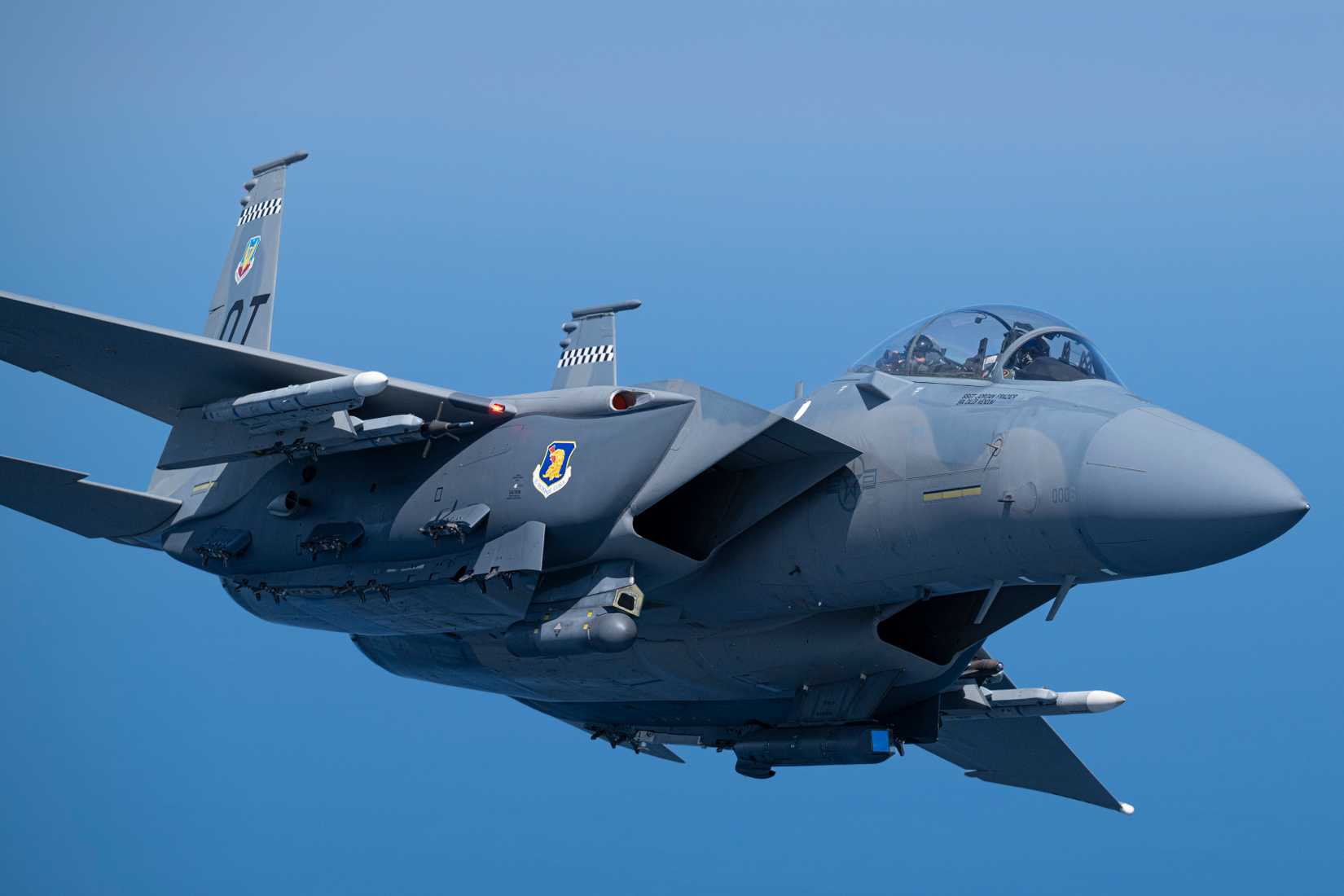
What makes the F-15EX strategically credible rather than merely expedient is the degree to which Boeing has modernized the platform's core avionics and electronic warfare architecture. The Advanced Display Core Processor II executes 87 billion operations per second, enabling sensor fusion and Open Mission Systems software upgradeability that functionally places the Eagle II's data processing in a different tier from any other fourth-generation fighter currently flying. The AN/APG-82(V)1 AESA radar and the BAE Systems-developed Eagle Passive/Active Warning and Survivability System — which completed Initial Operational Test and Evaluation in early 2024 — give the aircraft full-spectrum electronic warfare coverage including radar warning, geolocation, and active countermeasures as standard production equipment. The Pentagon's Director of Operational Test and Evaluation formally assessed the F-15EX as operationally effective across all air superiority roles, including offensive and defensive counter-air missions against surrogate fifth-generation adversary aircraft, a finding that carries significant institutional weight in force structure debates. The aircraft's Mach 2.5 top speed also remains unmatched among operational US fighters, a capability with direct relevance to homeland defense alert and intercept missions.
The Air Force's publicly articulated force structure language now reflects a deliberate three-tier architecture: the F-15EX serving as a high-payload missile truck and homeland defense platform, the F-35A penetrating high-threat environments where low observability is non-negotiable, and the next-generation F-47 eventually assuming the most contested air dominance roles. An Air Force spokesperson's confirmation to Military Times that the future fighter force "will be comprised of a mix of 4th, 5th, and next-gen fighters" is not hedging language — it is a formal strategic posture that allocates roles by mission environment rather than by platform generation. The Eagle II's capacity to carry up to 22 air-to-air missiles positions it specifically as a volume-fire platform for large-scale air campaigns and Indo-Pacific contingencies where magazine depth and sortie sustainability matter as much as stealth. This tiered logic addresses a real operational gap: the F-35's relatively limited internal weapons load becomes a strategic constraint in high-tempo, attrition-based air campaigns, and the F-15EX is explicitly designed to compensate for that limitation.
For aviation operators and professional pilots, the F-15EX expansion carries practical airspace and operational implications that extend beyond pure defense procurement. Increased Eagle II basing at continental US installations — particularly those supporting NORAD alert commitments — will affect airspace management, Notice to Air Missions activity, and flight restriction coordination across a range of operating environments. The Air National Guard, which has historically operated the F-15C/D and F-15E in significant numbers, is a likely recipient of Eagle II airframes as older variants retire, meaning Guard bases across multiple states will see transition activity, airspace reservation patterns, and low-level training route utilization evolve over the next several budget cycles. Commercial and business aviation operators routing through corridors near traditional F-15 bases — Kadena, Elmendorf-Richardson, Langley, Barnes, and others — should anticipate sustained and potentially increased military airspace activity as the fleet grows and crews transition through formal weapons school and operational training pipelines.
The broader industrial and economic dimensions of this decision also matter to aviation stakeholders. Boeing's combat aircraft division has faced significant commercial program pressure, and the F-15EX contract expansion provides substantial production runway at St. Louis through at least the early 2030s. That production stability has downstream effects on the aerospace supply chain, supporting suppliers of avionics, propulsion components, and airframe structures that serve both military and commercial programs. The decision also underscores a durable reality in advanced military aviation: airframe generation matters far less than sensor, software, and electronic warfare integration, a principle directly applicable to the retrofit and avionics upgrade market that serves business aviation operators. As the Air Force continues expanding a 1970s-lineage airframe equipped with cutting-edge mission systems, the implicit endorsement of avionics-driven capability enhancement — over wholesale platform replacement — reinforces investment logic already well established in the Part 91 and Part 135 fleet modernization space.







 Read original article