Air Force One’s New Look: Ex-Qatari Boeing 747 Rolls Out In Trump’s New Livery
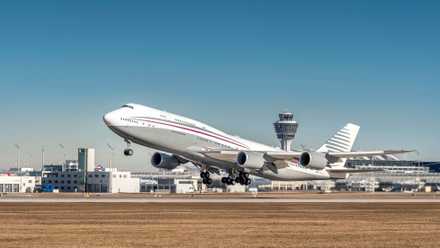
The former Qatari government Boeing 747-8, accepted by the United States in 2025 and currently undergoing modification for presidential transport duties, has emerged in a new red, white, and dark blue livery closely aligned with the color scheme President Donald Trump has long advocated for Air Force One. Images circulated on social media show the aircraft with a dark blue lower fuselage, white upper section, and red accent stripe — a design Trump first proposed during his initial term in office but which was shelved after engineering studies raised concerns that darker exterior paint could elevate fuselage temperatures and necessitate additional structural or thermal analysis. Defense contractor L3Harris is overseeing the conversion work, which requires integrating secure communications architecture, defensive countermeasures, cyber protection systems, and specialized mission equipment before the aircraft can assume any presidential transport role.
The interim conversion is a direct response to chronic schedule failures in Boeing's VC-25B program, the officially contracted replacement for the aging VC-25A fleet that has served as Air Force One for decades. The VC-25B contract, awarded in 2018, has slipped several years beyond its original delivery schedule while accumulating substantial cost overruns, a situation that led the current administration to pursue the ex-Qatari jet as a bridging solution. The 747-8 platform is operationally relevant as a stopgap precisely because it shares its airframe family with the VC-25B, meaning ground support infrastructure, crew qualification pathways, and certain systems knowledge will carry forward. For pilots and flight departments tracking large-cabin widebody operations, the reuse of a commercial VIP airframe as a government platform underscores how complex — and expensive — the delta between civilian luxury configuration and mission-capable government transport actually is, even when the base airframe is already sophisticated.
From a certification and modification standpoint, the project illustrates challenges that resonate across the spectrum of government, corporate, and special mission aviation. Converting an existing airframe to meet classified communications, electromagnetic hardening, and defensive systems requirements demands a level of supplemental type certificate work and military qualification review that dwarfs typical business aviation refurbishment projects. Operators in the Part 91K and Part 135 large-cabin space regularly navigate STC complexity during major avionics upgrades or interior reconfigurations, but the presidential mission profile layers in requirements — including nuclear command and control communications compatibility — that push the engineering scope into an entirely different category. The timeline uncertainty surrounding final certification of the ex-Qatari aircraft reflects that reality, and the public emergence of the new livery, while symbolically significant, does not itself indicate operational readiness.
The broader industry context involves Boeing's continuing difficulty executing large, complex government contracts on schedule, a pattern that has drawn scrutiny across multiple defense programs simultaneously. The VC-25B delays are not isolated; they reflect workforce, supply chain, and engineering capacity pressures that have also affected the 777X commercial program and several defense platforms. For aviation professionals monitoring manufacturer health, these delays carry downstream implications for fleet planning, whether at airlines evaluating new widebody deliveries, corporate operators awaiting factory-new business jets, or defense customers managing aging fleets. The decision to acquire and convert a third-party airframe rather than wait indefinitely for a contracted replacement represents a pragmatic — if logistically complex — workaround that other large fleet operators have occasionally mirrored when primary procurement channels stall. The repainting of the aircraft in the administration's preferred livery, regardless of final service entry date, signals that the program has cleared at least one visible milestone and that the interim Air Force One concept has moved well beyond a political proposal into an active modification effort.








 Read original article