Only 4 Airlines Still Fly Passenger Boeing 747s: Here's What A Premium Class Ticket Costs
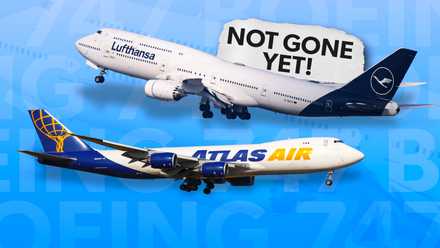
The Boeing 747's commercial passenger career is in its final chapter, with only four airlines worldwide maintaining scheduled passenger operations on the type as of mid-2026. The article documents the stark contraction of what was once the dominant long-haul widebody platform: Lufthansa remains the largest operator with 26 aircraft spanning both the 747-400 and 747-8 variants, while Air China fields seven commercially active 747s (with two 747-8s reserved for presidential transport), and Korean Air operates just four 747-8s en route to a full retirement by 2031. The fundamental commercial case against the 747 is structural — the aircraft's four-engine operating costs and high seat counts require load factors that modern twin-aisle twinjets can sustain far more efficiently, a calculus that sealed the 747-8's fate as a sales disappointment and accelerated the 747-400's exit from premium fleets globally.
For professional pilots and flight department operators, the pricing data embedded in this analysis carries practical intelligence about where ultra-premium air travel revenue is concentrating. Lufthansa's 747-8 first class commands one-way cash fares between $8,000 and $16,000, while Air China's equivalent product on the same aircraft type reaches nearly $20,000 on trans-Pacific routing to JFK and Dulles. These are among the highest published one-way fares in global scheduled service, underscoring that the surviving 747 operators are deliberately preserving the type on their most lucrative routes — Lufthansa deploying 747-8s to Buenos Aires, São Paulo, Tokyo, Johannesburg, and major U.S. gateways, and Air China restricting international 747-8 use to Frankfurt, JFK, and Dulles only. The aircraft's continued viability, in other words, is entirely dependent on its ability to fill premium cabins at rates that justify the fuel burn differential versus a 787 or A350.
The cabin product differentiation across these three operators reveals how much the premium cabin arms race has complicated fleet standardization decisions. Lufthansa's 747-8 offers the incoming Allegris suite in first class and Collins Aerospace Diamond seats in business, but the identical Diamond seat is configured six-abreast on the 747-8 and seven-abreast on the older 747-400 — a meaningful passenger experience gap on the same airline. Korean Air, despite operating the smallest 747-8 fleet of the three, arguably fields the strongest premium product, with Kosmo Suite 2 suites featuring sliding doors and Collins Apex Suite business class offering direct aisle access to all 48 seats. Air China's first class relies on the older Safran Venus platform, a generation behind Korean Air's hardware, yet commands the highest cash pricing of any operator covered — a reflection of route exclusivity and demand dynamics rather than product superiority. For corporate travel managers and charter operators competing for executive travel budgets, these distinctions matter when advising clients on scheduled alternatives to private aviation on long-haul routes.
The broader fleet trend this article documents is the accelerating convergence of long-haul widebody operations around twin-engine platforms — specifically the Boeing 777X, 787, and Airbus A350 family. Lufthansa's 747-400 retirements are directly linked to incoming 777-9 deliveries, and Korean Air's 2031 747-8 phase-out timeline will similarly align with next-generation twinjet deliveries. The cargo sector, as the article notes, still operates a substantial 747 fleet because no direct freighter replacement has entered service at scale, but the passenger side has already made its decision. For flight crews currently type-rated on the 747, the window for meaningful scheduled flying on the type is narrowing to a handful of carriers and routes. The 747's commercial survival through mid-decade is less a story of the aircraft's enduring relevance than a story of how strategically a small number of carriers have sequenced their fleet transitions while extracting maximum yield from the remaining airframes.





 Read original article