Iberia’s Damaged Airbus A350-900 Returns To Service After New Winglet Arrives
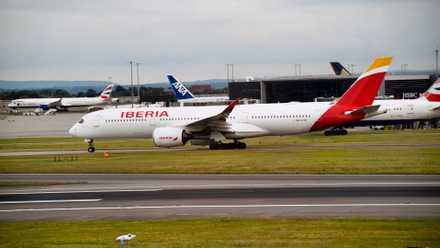
Iberia's Airbus A350-941 EC-NXD returned to commercial service on June 12 following a ground damage incident at José Joaquín de Olmedo International Airport (GYE) in Guayaquil, Ecuador, on June 4, in which the aircraft's left winglet made contact with airport firefighting equipment during a water-cannon salute. The aircraft, a 2022-delivery example powered by Rolls-Royce Trent XWB engines, sustained localized damage to the composite wingtip assembly while taxiing at low speed, forcing the cancellation of IB0262 to Madrid-Barajas and the immediate grounding of the airframe pending inspection and repair. Passengers were rebooked onto alternative services or rerouted through partner carriers. The compressed eight-day repair and return-to-service timeline reflects both the modular design philosophy of the A350 platform and the logistical capability of Iberia's maintenance infrastructure to source and integrate a replacement component under operational pressure.
The speed of the repair is directly attributable to how Airbus engineered the A350's composite wing architecture. The wingtip assembly on the A350 is designed as a discrete, replaceable structural element — mechanically and aerodynamically separate from the primary carbon-fiber wing box — allowing ground crews to remove and replace the damaged unit without disturbing the main load-bearing structure, its certified aeroelastic properties, or the defined aerodynamic profile of the wing platform. This modular approach, characteristic of Airbus's broader composite airframe maintenance philosophy, converts what could be a weeks-long repair on a metallic wing design into a targeted component exchange. For operators and MRO planners, this distinction is operationally significant: a damaged A350 wingtip does not automatically imply wing box inspection requirements or prolonged out-of-service periods, provided the primary structure is confirmed unaffected.
For line pilots and operations control personnel, the incident highlights a category of ground risk that receives comparatively little formal attention in operational risk frameworks — ceremonial airport procedures. Water-cannon salutes, while a long-standing tradition in global aviation, introduce a nonstandard operational element into what is otherwise a controlled ramp environment. The incident at GYE involved imprecise spatial coordination between the moving aircraft and positioned firefighting apparatus, a scenario that is not covered by standard taxi clearance procedures and depends almost entirely on informal coordination between airport fire services, ATC, and ground handlers. On the A350 specifically, the high-mounted, raked wingtip geometry extends the aircraft's lateral profile in ways that can be underappreciated by ground personnel accustomed to narrowbody or older widebody dimensions. Any aircraft taxiing through a ceremonial corridor with fire vehicles positioned along the route requires explicit clearance verification for all surface extremities, not just the fuselage centerline.
The broader operational impact on Iberia's network was contained by the rapid turnaround, but the scenario illustrates a vulnerability that is amplified across high-utilization fleets. Iberia's A350-900s anchor its intercontinental service to Latin America and North America from MAD, and each airframe in that fleet is typically scheduled with minimal slack. A prolonged grounding — had the damage extended to the primary wing structure or had a replacement wingtip not been available quickly — would have required substitution with A330-200 or A330-300 equipment, both of which carry lower passenger and cargo capacity on high-yield long-haul routes. The incident therefore functions as a case study in why A350 operators maintain close supply-chain relationships with Airbus and component vendors for common line-replaceable structural elements, and why fleet planners assign recovery buffer in long-haul schedules rather than treating aircraft availability as guaranteed.
At an industry level, the GYE incident adds to a small but growing body of documented cases in which ceremonial airport operations have resulted in aircraft damage or service disruption. Aviation regulators and airport authorities in several regions have begun scrutinizing the procedural rigor applied to water-cannon salutes, including required standoff distances calibrated to aircraft type, mandatory coordination checklists involving all participating parties, and explicit go/no-go authority assigned to a single coordinator before the aircraft begins moving through the salute corridor. For flight crews, situational awareness during these ceremonies is limited — the taxiing pilots have no direct sightline to the wingtip extremities — making pre-taxi briefings and confirmed ground team coordination a practical necessity rather than a courtesy. The Iberia incident, while resulting in only minor structural damage and a brief grounding, reinforces that ceremonial procedures carry genuine operational risk and warrant the same disciplined safety framework applied to any other nonstandard ground evolution.








 Read original article