Man Indicted After Live Bomb With 15-Minute Timer Found Before American Airlines Flight
Kimani Osayande Jones, a 49-year-old Sacramento-area man, has been indicted by a federal grand jury on three counts related to a foiled aircraft bombing attempt at Sacramento International Airport (SMF) on May 30, 2026. The charges include attempting to place a destructive device on an aircraft, unlawfully possessing explosive material in an airport, and attempting to carry a dangerous weapon or explosive onto an aircraft. Jones was intercepted at a TSA security checkpoint approximately one hour before his scheduled departure on American Airlines flight AA2464, a nonstop overnight service to Charlotte Douglas International Airport (CLT) operated by an Airbus A321 or A321neo. Authorities from the Sacramento County Sheriff's Office bomb squad and FBI confirmed that the recovered M-type explosive device contained viable powder and fuse material — not an inert or improvised prop, but functional destructive material ready to be used.
The operational significance of what was found in Jones's carry-on cannot be understated. Beyond the explosive device itself, his bag contained a knife, scissor blades, an aerosol can, zip ties, a torch lighter, and five mobile phones — one of which displayed a 15-minute countdown timer ready to activate. TSA testing concluded that detonation near an aircraft window above 10,000 feet could have caused structural damage and cabin depressurization. For crews operating the A321 on a four-hour-forty-one-minute overnight crossing at cruise altitudes typically above FL350, a rapid decompression event in the cabin — particularly if accompanied by structural compromise — would have placed passengers and crew in immediate life-threatening danger. The scenario underscores why threats to pressure vessel integrity represent one of the most catastrophic failure modes in commercial aviation operations.
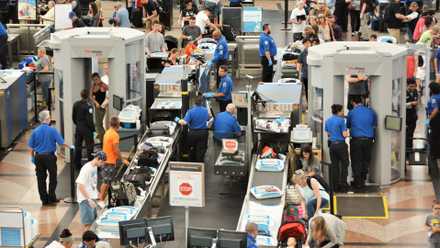
Jones's appearance at the checkpoint — wearing a face covering and blue latex gloves — drew visual suspicion from TSA officers before any screening technology flagged his bag, a detail that highlights the continued importance of behavioral detection as a layer of security independent of physical screening systems. His refusal to submit to an interview after offering to discard the items removed any ambiguity about intent. For airline crews and Part 121 operators, this case is a reminder that the sterile area checkpoint is not the final line of defense but the most critical one — and that behavioral anomalies at the checkpoint remain a legitimate and effective detection tool even as screening technology becomes more sophisticated.
The flight itself, AA2464, operates once daily between SMF and CLT, an American Airlines hub inherited from the US Airways merger. Charlotte serves as one of American's primary East Coast connection hubs, meaning the overnight arrival at 5:44 AM feeds directly into a busy early-morning bank of departures. A successful attack on this routing would not only have affected the 180-plus passengers and crew aboard the A321, but would have cascaded disruption across Charlotte's connecting traffic at a high-throughput time window. For corporate flight departments and charter operators who routinely transit CLT and SMF, security incidents at major commercial hubs have downstream effects on airport operations, ground handling, and airspace management that can affect even non-commercial traffic in the vicinity.
This incident arrives against a backdrop of sustained concern within the aviation security community about the evolving nature of insider and passenger-borne threats to commercial aviation. The sophistication of the device — multiple potential detonation methods, a pre-set timer, and viable energetics — distinguishes this case from impulsive or poorly planned attempts. Federal prosecutors pursuing a three-count indictment signals that authorities are treating this as a serious, premeditated plot rather than a checkpoint violation. For pilots and operators, the broader implication is straightforward: the TSA checkpoint system, when functioning as intended with both human behavioral observation and technological screening, remains the most consequential barrier between a threat actor and a commercial aircraft — and this case represents one of its clearest recent successes.





 Read original article