Bombardier delivers first Global 8000 in Africa to Nigeria’s BUA Group | Corporate Jet Investor | CJI news
Bombardier's delivery of the first Global 8000 on the African continent to Nigeria's BUA Group marks a notable milestone in the ultra-long-range business jet segment, placing one of the industry's most capable purpose-built corporate aircraft at a base in Lagos. BUA Group, a Nigerian multinational with holdings across cement manufacturing, food processing, oil and gas, energy infrastructure, and real estate, has now accumulated three Bombardier-delivered aircraft, with the Global 8000 representing the flagship addition. The delivery underscores the growing demand from African conglomerates for intercontinental reach without intermediate fuel stops, a requirement that has historically forced Nigerian-based operators to route through European hubs or accept longer overall city-pair times.
From an operational standpoint, the route set identified by BUA Group — Lagos (DNMM) to Los Angeles, Perth, and Tokyo — represents some of the most demanding city-pair missions a corporate flight department can plan. Each of those routes falls in the 7,400 to 7,700 nautical mile range, pushing close to the aircraft's published 8,000 nm ceiling and leaving limited margin for routing deviations, holding, or adverse winds aloft. Flight crews operating these legs will be working within the bounds of international crew rest regulations, making the Global 8000's dedicated crew rest area not simply a marketing feature but a functional necessity for legal compliance on segments exceeding 14 to 16 hours of block time. The aircraft's Mach 0.95 top speed provides meaningful schedule advantages on these ultra-long segments compared to competitors operating at Mach 0.87 to 0.90, potentially reducing flight times by 30 to 45 minutes on Pacific crossings.
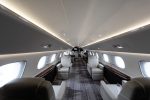
The Global 8000's cabin altitude of 2,691 feet at cruise is one of the most frequently cited differentiators in the ultra-long-range category. For corporate flight departments conducting high-value passenger missions, the physiological advantages of a lower effective altitude — reduced fatigue, better hydration retention, and more restful sleep — translate directly into productivity for executives arriving at destinations like Tokyo or Perth after 16-plus hours airborne. The four-zone cabin configuration further addresses the challenge of occupying a large group of executives or support staff for extended periods without the cabin environment becoming fatiguing in its own right. These factors are increasingly central to how Part 91 and Part 135 operators in the high-net-worth sector justify ultra-long-range aircraft selection.
The broader significance of this delivery lies in what it signals about African business aviation's trajectory. West Africa, and Nigeria in particular, has historically been underserved by original equipment manufacturer attention relative to the purchasing power concentrated within its corporate and governmental sectors. BUA Group's acquisition of the Global 8000 reflects an accelerating pattern among African multinationals of eliminating dependence on commercial airline routing for senior executive travel on intercontinental missions — a strategic shift that has been observable in North Africa and South Africa for longer, but is now increasingly visible in sub-Saharan markets. For Bombardier, establishing a flagship Global 8000 presence in Lagos provides a visible proof-of-concept for the aircraft's operational suitability in African conditions and a reference point for future sales discussions with other Nigerian and West African operators. The delivery also positions Bombardier competitively against Gulfstream's G700 and G800 in a market segment where the manufacturer battle for ultra-long-range supremacy remains active and consequential.