Here's What United Airlines Actually Spends Per Passenger On Its Polaris Business Class Amenities
United Airlines' Polaris business class product has long been positioned as a flagship differentiator in the competitive North Atlantic and transpacific premium cabin market, yet the carrier has never disclosed the actual per-passenger cost of the amenities it provides. Because neither SEC filings nor public announcements contain unit-level economics for business class service, any realistic estimate requires triangulating from secondary-market data, procurement logic, and the fundamental distinction between consumable and reusable goods. That gap between marketing narrative and operational reality is precisely what makes the analysis of Polaris spending relevant beyond traveler-facing comparisons.
The most analytically useful data point available is the secondary resale market for sealed Polaris amenity kits, which consistently prices complete kits in the $12–$14 range. Since airline procurement at scale almost always occurs below consumer resale pricing, the carrier's actual unit cost for a Therabody-branded kit — including earplugs, skincare products, toothbrush, socks, and the reusable cross-body bag itself — almost certainly falls below that range. For operators accustomed to thinking in terms of catering weights, galley provisioning costs, and per-diem allowances, this framing is instructive: the amenity kit, despite being the most visible take-home element of the Polaris experience, likely represents one of the smaller line items in total business class service cost.
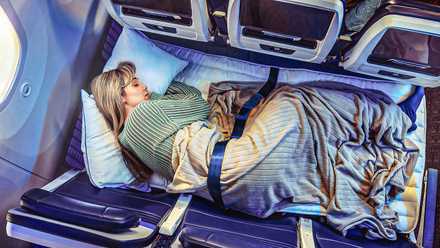
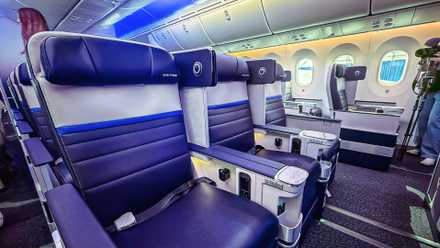
The more significant cost consideration lies in the reusable asset base — duvets, pillows, mattress pads, and slippers — which United markets aggressively as differentiators, including the claim of being the only U.S. carrier offering two pillows in business class. These items carry meaningful retail value and substantial procurement, laundering, logistics, and shrinkage costs across a fleet of wide-body aircraft operating long-haul international routes. However, amortizing those costs across hundreds of uses per item means the true per-passenger cost is a fraction of any retail equivalent. The common mistake — treating a Saks Fifth Avenue blanket as though its full retail price accrues to each passenger — systematically overstates business class provisioning expense in ways that can distort competitive cost comparisons between carriers.
For professional pilots and aviation operators, the underlying economics of premium cabin provisioning matter in ways that extend beyond curiosity about airline financials. Airlines funding premium cabin upgrades — bedding partnerships, elevated catering, dedicated lounge facilities — are making capital allocation decisions that directly affect route economics, aircraft utilization targets, and the unit revenue thresholds required to justify wide-body deployment on thinner international markets. Part 135 and Part 91K operators face analogous decisions when configuring large-cabin and ultra-long-range jets for UHNW clientele: the marginal cost of premium consumables is nearly always lower than perceived, while the amortized cost of cabin hardware and reusable soft goods dominates actual provisioning expense. Understanding how major carriers structure those trade-offs informs smarter procurement decisions at every level of the industry.
The broader trend visible in United's Polaris strategy — brand partnerships with Therabody, Sunday Riley, and Perricone MD replacing generic in-house products — reflects a wider shift in which airlines effectively outsource the marketing value of premium amenities to consumer brands while negotiating volume pricing that keeps per-unit costs well below consumer retail. This model, now common across international carriers including Lufthansa, Singapore Airlines, and Qatar Airways, allows airlines to communicate luxury positioning without proportionate increases in catering cost. The strategic implication is that the perceived value of a premium cabin product can be elevated substantially through partnership branding at relatively modest incremental expense, a dynamic that has intensified competition among U.S. carriers in the premium transoceanic segment and contributed directly to the continued expansion of Polaris-configured wide-body capacity on United's long-haul network.













 Read original article