Here's How Much A Business Class Ticket On Etihad Airways' Airbus A350 Actually Costs In 2026
Etihad Airways has built its entire A350 operation around a single variant — the larger A350-1000 — a strategic departure from the industry norm that sees most carriers split orders between the -900 and -1000. With 12 frames currently in service and 15 additional units on order, Etihad is deliberately leveraging the -1000's higher seat count and extended range to serve both ultra-long-haul markets like Atlanta (6,621 NM) and Sydney (6,510 NM) and relatively shorter, high-demand regional routes to Mumbai (1,065 NM) and Delhi (1,232 NM). The carrier's 371-seat dense configuration — 44 business and 327 economy — reflects a classic hub-and-spoke yield management philosophy: drive down per-seat operating costs while maintaining a sizable premium cabin to capture high-margin revenue on flagship routes. This all-in commitment to the -1000 is notable because it implies Etihad has calculated that the higher capacity and capability of the larger variant justify the increased acquisition and operating costs even on mid-range sectors where the smaller -900 would typically be the preferred tool.
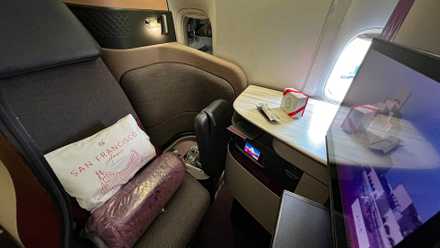
The business class product aboard these aircraft — the Collins Aerospace Elevation, a reverse herringbone configuration with a sliding privacy door — is a pragmatic but competitive choice for a carrier of Etihad's positioning. It is not a proprietary bespoke product like the carrier's own Business Studios on the A380, but the Elevation seat has achieved broad industry adoption across British Airways, Ethiopian, Malaysian, and Philippine Airlines, making it a known quantity among frequent long-haul travelers. At 21 inches wide with a 79-inch lay-flat bed and direct aisle access for all passengers in an 11-row, four-abreast layout, the product meets the baseline expectations of premium corporate and business travelers on routes of this length. For aviation operators and corporate flight departments benchmarking premium cabin standards for their own passengers or clientele, the Elevation represents the current mid-tier competitive floor for long-haul international business class — functional, spacious, and increasingly ubiquitous rather than differentiated.
Etihad's pricing strategy across the A350's route network illustrates the competitive pressure dynamics that shape premium cabin economics across different markets. The Atlanta route — Etihad's longest A350 operation at 6,621 NM — commands one-way fares from $4,700, while Sydney pushes above $6,000, reflecting thin competition on those ultra-long sectors from Abu Dhabi. The Seoul route demonstrates a significant asymmetric pricing structure, with Abu Dhabi departures reaching $4,300 to $5,800 but return segments from Seoul often falling below $2,000 — a classic supply-demand imbalance where competing Korean carriers and multiple Gulf hub options create downward fare pressure on the eastbound leg. Bangkok pricing, held between $2,000 and $3,000, reflects the density of competition on Gulf-Southeast Asia routing. For charter operators, corporate aviation departments, and airline planners, these fare ranges contextualize the going rate for long-haul international premium cabin travel and the degree to which route monopoly or near-monopoly status commands a meaningful fare premium.
The structure of Etihad Guest, the carrier's loyalty program, adds a further dimension relevant to frequent fliers in professional aviation. Unlike the revenue-based programs that have become standard across U.S. legacy carriers and are increasingly common globally, Etihad Guest remains distance-based with fixed, non-dynamic award pricing — a characteristic that creates genuine award value at scale for high-mileage travelers. The tiered status structure (Bronze through Emerald) affects award redemption rates, creating meaningful incentives for consistent flying. For corporate aviation departments managing travel programs across Part 91 and charter operations, Etihad's static award pricing model can represent better redemption value predictability than revenue-based programs that fluctuate with cash fare pricing, particularly on the high-fare ultra-long-haul routes where award seats can represent disproportionate value. This program design reflects a broader divergence in global airline loyalty strategy, where Gulf carriers have generally resisted the shift to fully revenue-based models that has characterized much of the U.S. and European airline space since 2014.








 Read original article