How The C-17 Globemaster Drops 25,000 Feet In 2 Minutes Using Inflight Reverse Thrust
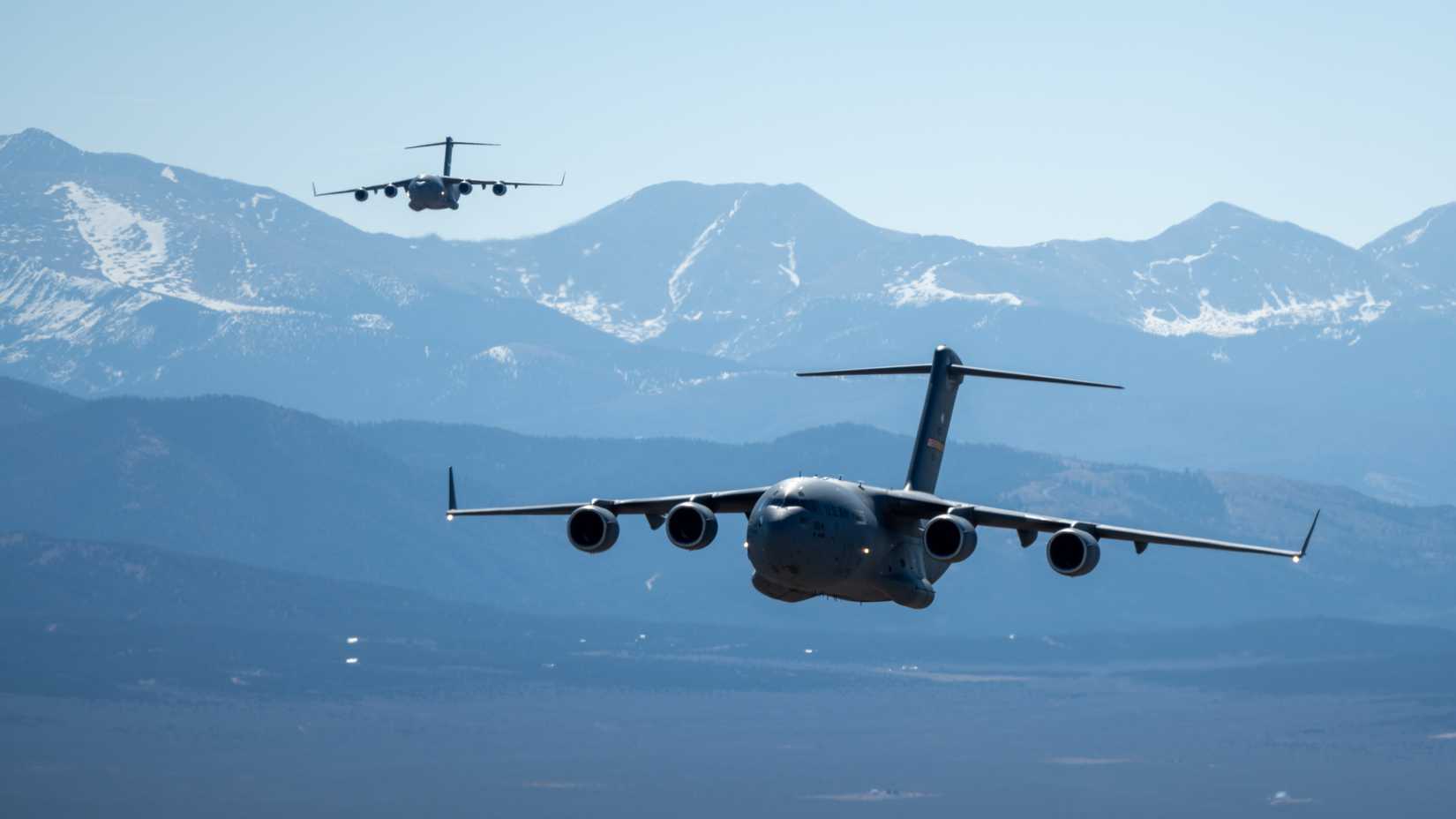
The Boeing C-17 Globemaster III employs a combat-specific reverse thrust system that enables descent rates of up to 15,000 feet per minute, allowing the aircraft to shed 25,000 feet of altitude in approximately two minutes during tactical approaches into hostile territory. The system works by sliding the outer nacelle cowl rearward on each of the four Pratt & Whitney F117-PW-100 engines, exposing a ring of cascading vanes that redirect 100 percent of the fan bypass airflow upward and forward at a 45-degree angle rather than laterally as on most commercial thrust reversers. This configuration generates extreme aerodynamic braking without inducing a wing stall, and the nose-down pitching moment it produces actively assists the steep descent profile. The vane geometry is also deliberately aimed to prevent FOD ingestion and cockpit visibility obstruction during ground operations, which is a critical design priority when operating on unimproved or debris-strewn surfaces in combat zones.
The tactical logic behind the system is rooted in the threat environment faced by airlift aircraft operating near or behind active front lines. Man-Portable Air Defense Systems such as the FIM-92 Stinger are generally ceiling-limited to roughly 10,000–15,000 feet, and anti-aircraft artillery effectiveness degrades significantly above 10,000 feet. By cruising at or above 25,000 feet and then executing an extremely rapid descent only when directly over the intended landing zone, the C-17 minimizes its exposure window to the most proliferated and accessible threat categories. Radar operators and visual observers on the ground also face a tracking geometry problem when an aircraft is descending nearly vertically overhead at high speed, further reducing targeting effectiveness. The same reverser system that enables the dramatic descent also allows ground repositioning — the aircraft can back up a 2-percent grade and execute 180-degree turns on narrow, austere strips, keeping ground exposure time to the absolute minimum before a rapid departure using externally blown flaps for short-field performance.
The powerplant itself connects directly to well-understood commercial aviation heritage, a fact relevant to pilots and operators who work with Boeing narrowbody equipment. The F117-PW-100 is a military derivative of the PW2000 series, the same engine family that powers the Boeing 757 in its PW2037 and PW2040 variants. The 757 has long held a reputation for exceptional hot-and-high performance and a favorable thrust-to-weight ratio relative to its peers, characteristics that made it a logical starting point for a tactical airlifter requiring both brute short-field capability and transatlantic range efficiency. The F117 retains a bypass ratio of 5.9:1, balancing the fuel economy needed for transoceanic ferry legs with the raw thrust output — 40,440 pounds per engine — required for externally blown flap operations that let the Globemaster approach at speeds as low as 115 knots while carrying payloads approaching 171,000 pounds.
For professional aviators, the C-17's reverse thrust architecture illustrates a design philosophy that has no direct civilian analog but carries important conceptual lessons about energy management, system integration, and threat-driven flight profile design. Standard transport category aircraft use thrust reversers exclusively as a ground deceleration aid, with in-flight deployment prohibited and treated as an emergency condition in most operating manuals. The C-17 inverts that assumption entirely, engineering the reverser as a primary flight control surface for vertical speed management. The externally blown flap system further blurs the boundary between propulsion and aerodynamic lift generation, a concept that saw limited commercial exploration in aircraft like the Boeing YC-14 and remains a defining feature of short-field military airlifters. Operators in the business aviation and Part 135 charter world who occasionally handle sensitive government cargo missions or diplomatic airlift in permissive but austere environments benefit from understanding the doctrinal and engineering constraints that govern military cargo operations, particularly as some operators transition crews between civilian and government contract work.
Broadly, the C-17's capabilities reflect the sustained relevance of purpose-built tactical airlifters in an era of increased competition in contested airspace. As proliferation of low-cost MANPADS and commercial drone technology continues globally, the same threat calculus that shaped the C-17's reverser design in the 1990s has become more acute, not less. Peer-competitor militaries have invested heavily in layered air defense systems, and the ability to minimize low-altitude exposure time during inbound and outbound transits has grown in operational importance. The Globemaster's design demonstrates that mission-specific aerodynamic and propulsion engineering, rather than off-the-shelf adaptation of commercial systems, remains essential when an aircraft must operate across the full spectrum from transoceanic cruise to combat assault landing on a dirt strip under fire.







 Read original article