Honeywell Sees ‘Emerging Gap’ Opening For Next-Gen HTF7000
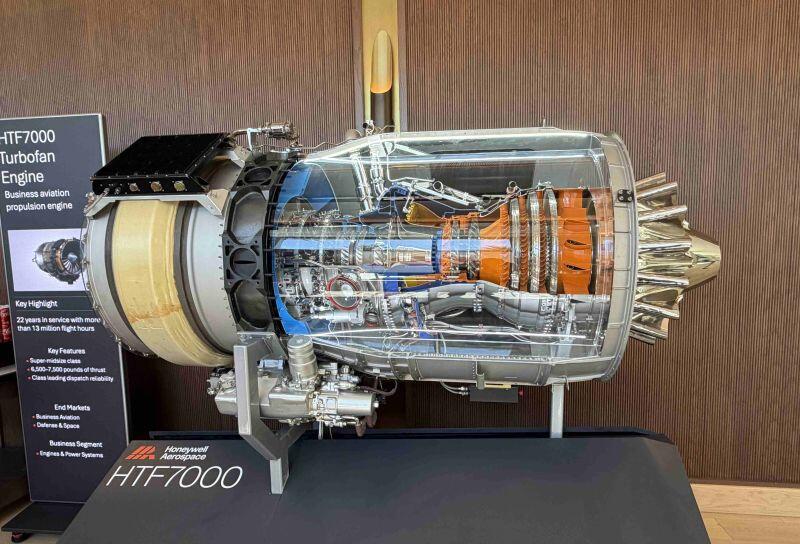
Honeywell Aerospace Technologies is advancing development of a new experimental high-pressure engine core that could form the technological foundation for a next-generation HTF7000 turbofan, along with a potential growth-thrust derivative targeting emerging large-cabin business jet applications. The company has characterized the market condition driving this effort as an "emerging gap" — a segment where current propulsion offerings are increasingly misaligned with the performance, efficiency, and range expectations of next-generation airframe programs now under development or in early design. The program also includes work on an advanced fan module and updated low-pressure architecture, suggesting a comprehensive clean-sheet or near-clean-sheet approach rather than an incremental upgrade to the existing HTF7000 line.
The HTF7000 family has powered the super-midsize and large-cabin segment for over two decades, most notably on the Bombardier Challenger 300 and 350 series and the Gulfstream G280, delivering thrust in the 6,900-to-7,900-pound class. While those platforms have remained commercially successful, the airframe market has been evolving steadily toward aircraft with greater range, higher cruise altitudes, and increased passenger capacity — characteristics that place new thermal and aerodynamic demands on propulsion systems. An experimental core program signals that Honeywell is moving beyond the derivative improvement cycle and investing in the kind of thermodynamic and materials research necessary to make meaningful specific fuel consumption and thrust-to-weight gains. For operators, this ultimately translates into lower fuel burn per nautical mile, reduced maintenance cost per flight hour, and the range capability that increasingly defines competitive aircraft selection in the large-cabin category.
For professional pilots and flight departments evaluating long-term fleet planning, the significance of this development extends well beyond hardware. Business jet procurement cycles routinely span a decade or more from program launch to fleet entry, meaning propulsion readiness is a critical gating factor for OEMs considering new aircraft. Honeywell's move to bench-test advanced core technology positions it to be a credible bidder on propulsion contracts for any next-generation large-cabin design that emerges from Bombardier, Dassault, Gulfstream, or other manufacturers in the coming years. The competitive dynamic is meaningful: Pratt & Whitney Canada, Rolls-Royce, and GE Aviation all maintain active development programs in adjacent thrust classes, and the manufacturer that demonstrates a mature, certifiable core earliest will carry significant leverage in airframe partnership negotiations.
The broader trend reflected in this announcement is an industry-wide recognition that the current generation of business jet engines — many of which entered service in the 1990s and 2000s — are approaching the limits of incremental improvement. Sustainable aviation fuel compatibility, stricter ICAO noise and emissions standards, and competitive pressure from urban and regional electrified platforms are all reshaping what OEMs and operators expect from turbofan propulsion over the next two to three decades. Honeywell's experimental core effort, while still at an early technology readiness stage, represents a strategic investment in remaining central to that next chapter of business aviation propulsion rather than ceding ground to competitors better positioned on advanced thermodynamics. Flight departments operating HTF7000-powered aircraft today should monitor this program as a leading indicator of future MRO cost structures, upgrade pathways, and resale value trajectories for their current assets.










 Read original article