Inside Qantas' Brand-New Pilot & Crew Rest Areas Built For 22-Hour Project Sunrise Flights
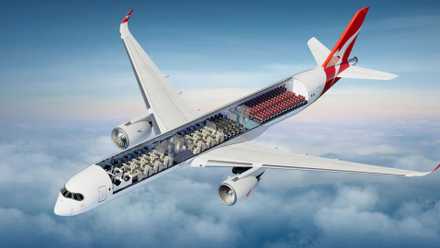
Qantas has publicly detailed the dedicated pilot and cabin crew rest compartments built into its specially configured Airbus A350-1000ULR aircraft for Project Sunrise operations, providing the most complete look yet at how the airline intends to safely conduct commercial flights lasting up to 22 hours between Sydney and destinations including London and New York. The pilot rest area features two lie-flat bunks and dedicated seating positioned away from the flight deck and passenger cabin, accessible via discreet stairways above the main cabin floor. Cabin crew have access to a separate, larger section with stacked bunks, privacy curtains, subdued lighting, and sound insulation. These facilities are not incidental amenities — they are formally integrated into the aircraft's design and represent a foundational element of the regulatory certification framework under which these flights will operate.
For professional pilots, the significance of these rest compartments extends well beyond their physical dimensions. Aviation fatigue science has advanced considerably over the past two decades, and modern flight and duty time regulations in Australia, the European Union, and the United States now treat physiological rest quality — not just hours off-duty — as a measurable safety variable. Qantas conducted research flights during the pandemic period, gathering biometric and alertness data on crew members throughout ultra-long-haul routes to inform both aircraft design and operational procedures. The resulting fatigue mitigation strategies govern not only when pilots sleep but how meals are timed, how cabin lighting is managed, and how handoff protocols between augmented crew members are sequenced across duty periods that may run beyond 20 hours. For airline crews on augmented operations, this represents a maturation of fatigue risk management from policy document to engineered physical infrastructure.
The A350-1000ULR configuration Qantas has selected for Project Sunrise reflects a deliberate trade-off familiar to operators of ultra-long-range business jets: reduced passenger count in exchange for range, premium cabin space, and crew support systems. The aircraft carries fewer seats than a standard A350-1000 widebody, freeing volume for additional fuel capacity, wellness areas, and the expanded crew rest zones. This architectural logic parallels decisions made in Part 91K and Part 135 ultra-long-range operations, where Gulfstream G700 and Bombardier Global 7500 operators have similarly wrestled with how to configure aircraft interiors for missions approaching or exceeding 14 hours, including the placement and quality of pilot rest positions when augmented crews are carried. The regulatory and ergonomic arguments are structurally identical, even if the scale differs dramatically.
Project Sunrise sits at the practical boundary of what current commercial aviation technology can sustain, and the crew rest facilities reflect that reality. Airlines operating existing ultra-long-haul routes — Singapore Airlines' Singapore-to-New York service aboard the A350-900ULR, and Qatar Airways' comparable offerings — have already demonstrated that flights in the 17-to-19-hour range are operationally viable with proper crew management. Qantas is extending that envelope by two to four additional hours, which introduces meaningful new physiological demands and requires correspondingly more robust fatigue mitigation infrastructure. Regulatory approval from the Civil Aviation Safety Authority and coordination with international bodies will hinge in part on demonstrating that the rest compartments deliver genuine restorative sleep, not merely compliant laydown time, a distinction fatigue researchers and certificating authorities increasingly scrutinize through data rather than self-reporting.
When Project Sunrise enters service later this decade, it will establish a new operational benchmark for ultra-long-haul commercial aviation and will likely influence how regulators, aircraft manufacturers, and operators think about crew welfare on future extended-range programs. The precedent is already visible in the business aviation sector, where manufacturers have begun marketing crew rest solutions on long-range platforms as operational necessities rather than luxury options. As nonstop city pairs that were once considered impractical become commercially viable through improved airframe efficiency and fuel systems, the question of how flight crews remain physiologically capable across those missions becomes an engineering problem as much as a scheduling one — and Qantas' Project Sunrise infrastructure offers one detailed answer to that problem at the highest level of commercial aviation ambition.





 Read original article