5 McDonnell Douglas Aircraft That Changed Commercial Aviation
McDonnell Douglas occupied a defining position in commercial aviation history as the world's second-largest commercial aircraft manufacturer from its 1967 formation through its 1997 merger with Boeing, and its aircraft programs shaped the operational landscape that professional pilots navigated for decades. The company emerged from the merger of Douglas Aircraft — already strained financially by the concurrent DC-8 and DC-9 development costs — and McDonnell Aircraft, which lacked civilian revenue and was vulnerable to cyclical military contracting. The combined entity maintained Douglas's commercial lineage while leveraging McDonnell's defense expertise, producing aircraft that ranged from short-haul narrowbodies to transcontinental widebodies, and its decisions around airframe longevity, engine selection, and market timing carry direct relevance to understanding the modern fleet compositions still operated by Part 91, 135, and airline operators today.
The DC-8 Super 70 reengining program stands as one of the most consequential fleet modernization decisions in commercial aviation history, and its implications extend directly to how operators today evaluate power plant upgrades against new-build acquisitions. When United Airlines selected the CFM56-2 in 1979 to re-engine its DC-8-61 fleet, and when Delta Air Lines and Flying Tiger Line followed, McDonnell Douglas facilitated the reengining of more than 100 DC-8s into the Super 70 series. The result was a dramatic extension of airframe service life well beyond that of the Boeing 707, which lacked a comparable reengining pathway and exited passenger service far earlier. Crucially, the DC-8 Super 70 program served as an early commercial proving ground for the CFM56 — the engine now recognized as the most successful commercial jet engine in history, powering the Boeing 737 Classic, 737NG, and Airbus A320ceo families. The lesson embedded in this history is one that fleet planners and chief pilots at major operators continue to apply: the economics of reengining an airframe with modern high-bypass turbofans can dramatically alter noise compliance, fuel burn, and remaining service utility in ways that defer capital expenditure without sacrificing operational performance.
The MD-80's market entry in 1980 represents a case study in the strategic importance of timing over raw performance specification, a dynamic that resonates with modern operators evaluating aircraft transitions. The MD-80, a substantial overhaul of the DC-9 featuring fuselage stretching, wing improvements, higher maximum takeoff weight, and Pratt & Whitney JT8D-200 series engines, effectively matched the Boeing 727's payload-range capability while reducing fuel consumption and eliminating the requirement for a flight engineer. This was not incidental — the MD-80 entered service four years before the Boeing 737-300 and eight years before the comparable 737-400, while the Boeing 757 that arrived in 1983 was a larger, more expensive platform that addressed a different market segment. Airlines retiring 727 fleets in the early 1980s had a commercially viable narrowbody replacement available in the MD-80 precisely when they needed one, and nearly 1,200 examples were sold. For pilots who flew the type at American, Delta, or Allegiant — the last major U.S. operator to retire its MD-80 fleet, completing the process in 2020 — the aircraft was known for its distinctive rear-engine configuration, high tail, and handling characteristics that remained familiar across its long service career. Its commercial success also demonstrated that market window timing can outweigh incremental efficiency advantages held by competitors who arrive later.
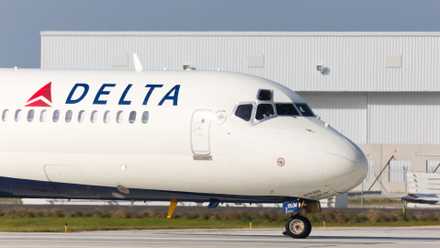
The broader McDonnell Douglas commercial legacy connects directly to the competitive architecture of today's commercial and business aviation market. The company's eventual inability to sustain investment across multiple concurrent development programs — the MD-11 widebody trijet, the MD-90 narrowbody, and the abortive MD-12 four-engine widebody — reflected a structural resource constraint that Boeing exploited after the 1997 merger. McDonnell Douglas's commercial programs were ultimately absorbed or wound down, with the Boeing 717 (the rebranded MD-95) surviving the longest before Delta retired its final examples under an accelerated timeline. The competitive pressure that McDonnell Douglas placed on Boeing throughout the 1970s and 1980s arguably drove Boeing to develop more capable variants of the 737 and 747 than it might otherwise have pursued, shaping the product lines that dominate airline and charter fleets today. For corporate flight departments evaluating long-term fleet strategy and airline operators managing transition timelines, the McDonnell Douglas story illustrates that competitive advantage in aviation is rarely permanent — fleet modernization decisions, engine selection partnerships, and market timing each carry consequences that compound across decades of aircraft service life.







 Read original article