Why The B-21 Raider Can Park Outside Overnight – Something The B-2 Spirit Could Never Do
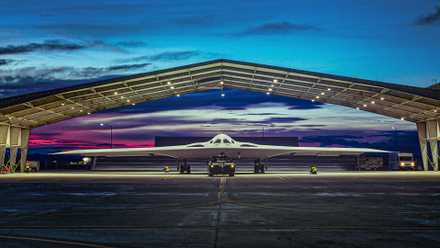
The B-21 Raider represents a deliberate strategic and engineering departure from the B-2 Spirit, built around the US Air Force's Agile Combat Employment doctrine, which demands that frontline aircraft operate from dispersed, austere bases without specialized infrastructure. Where the B-2 required climate-controlled hangars, extensive ground support equipment, and continuous maintenance attention to preserve its low-observable coatings — constraints that effectively tethered the fleet to a handful of prepared facilities worldwide — the Raider is engineered from the outset to park outside, sustain operational tempo in harsh environments, and be serviced with a minimal footprint. The aircraft's reduced dimensions, with a wingspan expected to measure between 132 and 150 feet compared to the B-2's 172-foot span, allow it to fit within hardened aircraft shelters originally built for Cold War-era fighter jets, dramatically expanding the number of viable operating locations across theaters like the Indo-Pacific.
The 2008 loss of the *Spirit of Kansas* at Andersen Air Force Base in Guam, the only B-2 ever destroyed, remains one of the most consequential and instructive mishaps in modern military aviation history. A NASA investigation determined that an undocumented moisture-removal workaround applied to the Port Transducer Units — a field-improvised technique not captured in official maintenance documentation — corrupted air data inputs to the fly-by-wire flight control system. On takeoff roll the following morning, the corrupted data produced a stall warning and uncommanded pitch-up, resulting in immediate loss of control, a crash, and total destruction of a platform valued at approximately two billion dollars. Both crew members ejected successfully, though one sustained a significant spinal injury. The mishap illustrated with brutal clarity how the intersection of poor documentation, institutional knowledge gaps, and a fundamentally moisture-sensitive airframe could defeat a machine that no adversary had ever managed to touch.
For professional pilots and aviation operators, the B-21 program's engineering philosophy carries direct relevance to how maintenance documentation, systems complexity, and operational environment interact with airworthiness. The B-2 mishap was not a crew error in the conventional sense — it was a systemic failure rooted in the absence of formalized procedures for a known workaround, combined with a design architecture that offered almost no tolerance for degraded sensor inputs. The fly-by-wire system on a flying wing configuration has no passive aerodynamic stability to fall back on, meaning corrupted air data translates immediately into catastrophic handling characteristics with no recovery margin. This mirrors lessons that have appeared repeatedly across commercial aviation — the 737 MAX MCAS accidents, Air France 447, and others — where the interface between automated systems, sensor inputs, and crew understanding of underlying system logic proved to be the actual failure point rather than any discrete mechanical failure.
The B-21's reported improvements in stealth material durability, reduced maintenance burden, and compatibility with standard fighter infrastructure also reflect a broader industrial trend toward designing military and commercial aircraft for reduced lifecycle cost and greater operational flexibility. In business aviation, operators increasingly evaluate aircraft acquisitions not just on range and payload but on maintenance accessibility, parts commonality, and the ability to support the aircraft at international FBOs and MRO facilities rather than dedicated factory-authorized centers. The shift away from hangar-queen platforms in military aviation parallels the commercial push toward aircraft like the Gulfstream G700 or Dassault Falcon 10X, which are engineered to operate from a wider range of international airports with less infrastructure dependency than older long-range jets. The strategic logic is identical: an aircraft that requires ideal conditions to operate is an asset with a ceiling on its utility.
The B-21 program also underscores the growing importance of multispectral stealth material science as a discipline distinct from aerodynamics or propulsion engineering, and signals where the long-term maintenance burden for next-generation aircraft — military and potentially commercial — will reside. The B-2's low-observable coatings required specialized repair facilities because the materials could not tolerate exposure to moisture, temperature extremes, or standard flight line conditions. The Raider's ability to sustain these properties in austere environments suggests advances in coating chemistry and substrate engineering that will almost certainly find application in commercial radar-absorbing or signature-reducing surface treatments as airspace management and counter-UAS technologies evolve. For operators planning long-term fleet strategy, the trajectory of materials technology coming out of programs like the B-21 is worth monitoring, as it tends to migrate into commercial certification frameworks within a decade of initial military deployment.










 Read original article