American Airlines Strips Screens From 23 Airbus A319s As 1st Retrofitted A320 Enters Service
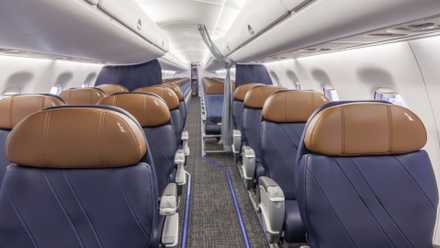
American Airlines is advancing a significant narrowbody cabin transformation program, with 23 of its 32 legacy Airbus A319s already retrofitted and the first A320 having entered service in the new configuration as of late June 2026. The overhaul removes seatback in-flight entertainment screens entirely, expands first class seating on the A319 from eight to 12 seats and on the A320 from 12 to 16 seats, installs larger overhead bins, and adds power outlets at every seat. The new interior aligns these older aircraft with the cabin aesthetic debuted on American's A321XLRs and newly delivered 787-9 Dreamliners, though the absence of seatback screens marks a deliberate divergence from those premium widebody configurations. The retrofit program, which was originally planned around the Oasis interior concept before pivoting to the current design, began in earnest when prototype aircraft N9002U returned from a five-month maintenance period in El Salvador in February 2026.
The A320 retrofit introduces notable configuration complexity that carries operational relevance. To accommodate 33 Main Cabin Extra seats — up from 18 previously — while holding total capacity at the 150-passenger limit, three seats in row eight on the left side were reportedly removed and replaced with a closet structure behind first class. An additional blocked middle seat near the rear is under discussion. For pilots and dispatchers, this matters because exceeding 150 passengers aboard the A320 would trigger a fourth flight attendant requirement under FAA crew ratio rules, meaning load control, boarding procedures, and weight-and-balance calculations on these aircraft need to account for the revised seat map until configurations are fully documented and stabilized across the fleet. Crews operating reconfigured airframes should verify current aircraft-specific documentation, particularly during the transition period while retrofits are still rolling out across the subfleet.
The broader operational picture concerns fleet longevity. American's A319s carry an average age of 22.2 years, while its 48 A320s — all inherited from US Airways and America West — average 25.2 years. Projected retirement timelines that had pointed to retirements beginning as early as 2026 have since been pushed to at least 2030, and the active investment in cabin overhauls reinforces that these airframes will remain in scheduled service for years. For pilots holding type ratings on the A319 and A320, or for crews bidding these equipment types at American, the retrofits signal stable, ongoing deployment of aging but operationally committed narrowbodies rather than an accelerating wind-down. Maintenance teams and technical operations departments should also anticipate the removal of IFE system hardware as a recurring work package across the fleet, which simplifies some maintenance burden while potentially altering MEL considerations tied to passenger entertainment systems.
The decision to strip seatback screens rather than retrofit them reflects a deliberate cost and weight calculus increasingly visible across major U.S. carriers. American's move mirrors a broader industry pattern in which airlines invest capital in structural improvements — premium seating density, bin space, power infrastructure — while offloading entertainment delivery to passenger-owned devices and onboard Wi-Fi. The removal of IFE systems reduces aircraft weight, lowers fuel burn marginally across thousands of cycles, and eliminates a historically maintenance-intensive component. This trade-off is particularly pronounced on short- to medium-haul narrowbody operations where passengers already rely heavily on personal devices. American's premium seat expansion strategy — targeting more than 20% fleetwide premium growth by 2026 through a combination of retrofits and new deliveries — is simultaneously a revenue optimization play that reshapes how load factors and yield management interact on these routes, which in turn affects scheduling, turn times, and gate handling protocols that frontline crews encounter daily.








 Read original article