Why The US Air Force Is Keeping 54 A-10 Warthogs Flying After Operation Epic Fury
The United States Air Force's decision to retain a residual fleet of 54 A-10 Thunderbolt II Warthogs through approximately 2029–2030 following Operation Epic Fury represents not a strategic reversal but a pragmatic concession to congressional pressure and near-term operational utility. The Air Force has sought to retire the A-10 since 1984 — the same year it received its final deliveries — and that institutional posture has not changed. What has changed is the pace of drawdown: the service is requesting retirement of 49 additional airframes in fiscal year 2027, which would reduce the inventory from roughly 103 aircraft to just 54, organized into three residual squadrons. The 2026 Iranian air campaign demonstrated the aircraft's continued relevance in permissive or semi-permissive environments — strafing Iranian-aligned militants in Iraq and Syria, conducting maritime strike operations against Iranian naval vessels in the Gulf, and providing close air support during the recovery of downed F-15E aircrew — but none of these missions required the A-10's unique capabilities in ways that other platforms could not eventually replicate.
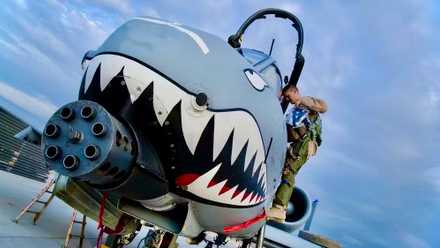
The A-10's origin story is inseparable from interservice rivalry, and understanding that history clarifies why the aircraft persists despite the Air Force's consistent efforts to shed it. The 1948 Key West Agreement assigned rotary-wing aviation to the Army, but when Lockheed's AH-56 Cheyenne — a compound helicopter capable of fixed-wing-like performance — threatened to encroach on the Air Force's close air support mission, Air Force lobbying contributed to its cancellation. Having successfully blocked the Army's advanced attack helicopter, the Air Force was politically cornered: it could no longer credibly argue against developing a dedicated CAS platform of its own. The result was the A-10, engineered specifically to blunt a Soviet armored thrust through West Germany's Fulda Gap, built around the 30mm GAU-8 Avenger rotary cannon and armored with a titanium crew protection structure. The Cold War rationale for that aircraft has been obsolete for three decades, and the Great Power Competition framework now driving Air Force investment — focused on long-range, survivable systems capable of operating against Chinese integrated air defense networks across the Pacific — leaves no role for a subsonic, low-altitude platform with limited range and high radar cross-section.
For working military aviators and defense-adjacent operators, the operational lessons from Epic Fury reinforce a pattern visible since at least Operation Desert Storm: the A-10 performs best in environments where adversaries lack meaningful air defense, and it faces significant attrition risk against any opponent with even modest SHORAD capability. The Gulf War saw 65 A-10s sustain combat damage, with 14 written off entirely — a loss rate that would be unacceptable in a high-end conflict. The 2025 modification of surviving airframes for a drone-hunting role reflects the Air Force's effort to extract additional utility from a sunk-cost asset, but it also signals the platform's transition from primary strike weapon to a niche, lower-threat-environment tool. Maritime strike against lightly defended Iranian vessels and CSAR support for downed aircrew represent exactly the kind of permissive, time-sensitive scenarios where the A-10's loiter time, payload, and pilot survivability features still provide genuine value over alternatives.
The broader implication for aviation operators and Part 91/135 contractors supporting defense logistics, ISR, or personnel recovery missions is that the U.S. military's tactical air support architecture is accelerating its shift toward standoff munitions, one-way attack drones, and multirole platforms with survivable electronic warfare suites. The A-10's retirement arc — from 722 delivered aircraft to a 54-airframe residual fleet over roughly four decades — mirrors the wider drawdown of single-mission legacy platforms across the services. Congress has repeatedly intervened to slow A-10 retirements, largely driven by constituent and Guard/Reserve employment concerns, but the trajectory is now irreversible. By 2030, barring another major contingency that validates the aircraft's niche utility in a way Congress cannot ignore, the Warthog's operational history will effectively close — not because it failed, but because the threat environment it was designed to defeat no longer defines American military planning.







 Read original article