Boeing’s Long Arc from Disciplined Rework to Distributed Chaos
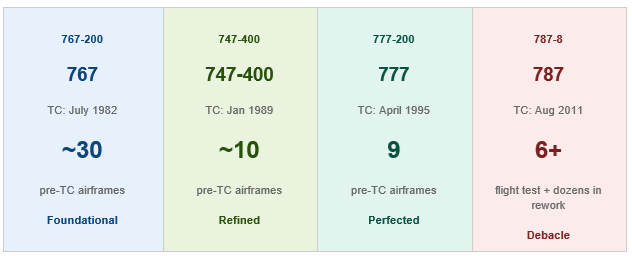
Boeing's pre-production change incorporation process — the mechanism by which design modifications are absorbed into aircraft already on the assembly line before type certification is complete — sits at the operational and financial heart of the manufacturer's current recovery challenge. Leeham News opens a five-part series by establishing the foundational tension that has plagued multiple Boeing programs: the economic imperative to begin assembling aircraft before certification concludes necessarily creates a pipeline of airframes that must be retroactively updated when design changes emerge from flight test. When that process is well-managed, as Boeing historically demonstrated on programs like the 737 Classic and original 777, the rework is controlled, scoped, and absorbed within acceptable budget and schedule tolerances. When it breaks down — as the article indicates occurred across the 767, 747-400, and 787 programs to varying degrees — the consequences cascade through delivery schedules, customer relationships, and the manufacturer's capital position simultaneously.
The economic logic the article describes is well understood across the aerospace industry: new program investment runs into the billions, and every month between first flight and first revenue delivery represents continuing capital consumption against contracted obligations. Airlines building route networks, training pipelines, and fleet retirement schedules around delivery dates have little tolerance for slippage, and lessors and financiers structuring deals around delivery milestones even less. This creates institutional pressure to begin assembly at volume as early as possible, which in turn amplifies the scope and complexity of any change incorporation effort when test aircraft surface unexpected design issues. The 787 program became the industry's most documented case study in how supplier-distributed manufacturing — spreading subassembly work across a global network of partners — compounds that complexity by creating configuration-control gaps that a single integrated factory might have contained.
For working pilots and operators, the significance extends well beyond production history. Aircraft entering service from programs that experienced significant pre-delivery rework carry residual risk in the form of undocumented modifications, incomplete records, and maintenance ambiguities that surface years later during heavy maintenance visits or unscheduled events. The 787's well-documented issues with shimming, fastener installation, and fuselage join quality — many traceable to the supplier-distributed model — translated into inspection requirements, airworthiness directives, and in some cases delivery holds that affected operator fleet planning. Part 91K and Part 135 operators who acquired early-production 787s or 747-8s often encountered maintenance complexity their initial cost models did not anticipate, and the Leeham analysis provides structural context for why those anomalies emerged.
The broader arc the series is tracing — from disciplined rework on the 767 to distributed chaos on the 787 — maps directly onto a widely recognized inflection point in Boeing's institutional culture. The 1997 McDonnell Douglas merger and the subsequent elevation of financial engineering priorities over manufacturing discipline have been extensively analyzed in the post-MAX accident literature. What the Leeham series appears positioned to add is a program-by-program forensic view of how those cultural shifts manifested in the specific discipline of change incorporation, which is a more granular and operationally tractable frame than the broader cultural critiques. For Boeing's recovery to be credible, it must demonstrate not only that it has identified the philosophical failures but that it has rebuilt the procedural and organizational infrastructure — configuration control, supplier oversight, pre-delivery documentation integrity — that made disciplined change incorporation possible in earlier program generations. The five-part format suggests the analysis will ultimately arrive at prescriptive conclusions about what genuine recovery requires, which makes it essential reading for operators evaluating fleet decisions involving current and near-term Boeing deliveries.




 Read original article