Boeing Archives - Leeham News and Analysis
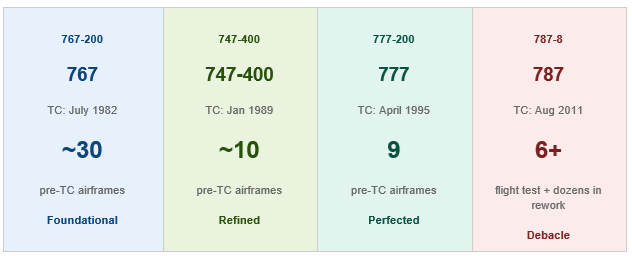
Boeing's ongoing struggle with pre-production change incorporation — the costly process of modifying aircraft already on the assembly line before a type certificate is issued — forms the backbone of a five-part Leeham News series examining the manufacturer's path toward operational and financial recovery. The series argues that Boeing's problems in this domain are not new, tracing a through-line from a 30-aircraft cockpit rework crisis on the 767 in the early 1980s to supplier-driven configuration failures on the 787 decades later. The core tension is structural: because a new commercial jet program burns billions of dollars in capital before the first revenue delivery, manufacturers begin assembling aircraft months or years before the FAA issues a type certificate. When late-stage design or regulatory changes arrive — as they inevitably do — the resulting rework on completed or partially completed airframes is exponentially more expensive and schedule-disruptive than resolving the same issue at the drawing board.
The 767 program serves as the series' central case study in how engineering ambition and economic pressure collide on the factory floor. Boeing and its airline customers were intensely motivated to certify the 767 for two-crew operations, eliminating the flight engineer position that had been standard on large transport jets since the jet age began. The financial arithmetic was compelling: eliminating one crew member per flight across a large fleet compounded into millions of dollars per aircraft per year in labor cost savings alone. A shared type rating with the concurrently developed 757 added further scheduling and training flexibility. But the battle over crew complement was not settled quietly — it played out as a live political and engineering dispute between Boeing, the airlines, the FAA, pilot unions, and regulators while the first 767 airframes were already being assembled in Everett. That sequencing mismatch — design fights still unresolved while metal was being cut — made the eventual cockpit rework across approximately 30 aircraft both inevitable and extraordinarily expensive.
The 747-400, which received its type certificate in January 1989, illustrates how the industry absorbed and institutionalized the two-crew lesson. By the late 1980s, the outcome was no longer in dispute: a presidential task force, the operational success of the 767 and 757 in revenue service, and revised union contracts had collectively settled the crew complement question in favor of two pilots. The 747-400's new glass cockpit reflected the maturity of that transition — reducing the total number of dials, gauges, and knobs from 971 on the analog three-crew flight deck to 365 through electronic systems integration. That reduction of nearly 62 percent in discrete instruments represents not just a technological achievement but a philosophical shift in how aircraft systems were designed to be monitored and managed, centralizing information flow through digital displays rather than distributing it across dedicated gauges and crew stations.
For working airline and business aviation pilots, the Leeham series carries direct relevance beyond historical interest. The two-crew standard that defines every modern transport-category flight deck — from the Boeing 737 and 787 to the Airbus A320 family and Gulfstream large-cabin jets — was not an inevitable technological progression. It was a negotiated outcome, fought over in regulatory proceedings, union contracts, and engineering review boards while real aircraft were being built. The economics that drove it remain the same economics that today pressure manufacturers toward single-pilot certification for regional and business turboprops, and that underpin ongoing EASA and FAA discussions about advanced automation enabling reduced crew operations on larger jets. The institutional memory of how painful and costly it was to change the 767 cockpit mid-production also speaks directly to current concerns about Boeing's manufacturing discipline and configuration control, issues that have been central to the 737 MAX and 787 quality crises of the past decade.
The broader trend the series surfaces is that Boeing's current quality and financial difficulties are not anomalies produced solely by the McDonnell Douglas merger culture or 2000s-era management decisions, but are the latest expression of a recurring failure mode with identifiable historical precedents. When schedule pressure and capital burn override disciplined change incorporation processes, the costs appear downstream as rework, certification delays, and delivery penalties — or, in worst-case scenarios, as safety events requiring fleet-wide action. For operators flying Boeing equipment or evaluating fleet decisions, understanding the manufacturer's historical relationship between engineering rigor and production economics provides important context for assessing the credibility of Boeing's stated recovery trajectory and the durability of its quality improvement commitments.








 Read original article