Premium Archives - Leeham News and Analysis
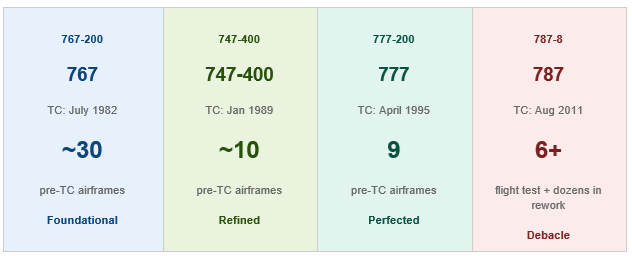
Leeham News and Analysis has launched a five-part investigative series examining Boeing's pre-production change incorporation history as a lens for understanding the manufacturer's current path to recovery. The series opens with the Boeing 767's foundational role in reshaping modern airline operations, specifically the political and engineering battle over crew complement that consumed the program even as the first aircraft were completing assembly in Everett. Historically, large transport category jets required a three-person flight deck — captain, first officer, and flight engineer — with the latter managing fuel, hydraulics, pressurization, and electrical systems too complex for two pilots to monitor while simultaneously flying. By the late 1970s, advances in avionics automation had matured to the point where a two-crew widebody was technically feasible, and Boeing, along with most airline customers, aggressively pursued that configuration for the 767. The financial calculus was unambiguous: labor cost differentials between two-crew and three-crew operations compounded into millions of dollars per aircraft annually across a fleet, and a shared type rating with the concurrently designed 757 offered additional scheduling and training efficiencies.
The 747-400, which rolled out in January 1988 and received its type certificate a year later, extended those lessons into one of aviation's most consequential derivative programs. The reduction from 971 instruments, dials, and controls to 365 through electronic systems integration stands as a quantitative measure of how dramatically cockpit design philosophy had evolved within a single generation. By the time the 747-400 entered service, the crew complement debate had been conclusively resolved — presidential task force findings, the operational success of the 757 and 767 in revenue service, and revised union contracts had established the two-crew standard as industry doctrine. The 747-400's winglets, extended-range capability, tail fuel tanks, and new interior were significant, but it was the glass cockpit and its two-pilot certification that defined the aircraft's strategic importance to operators.
For working airline and corporate pilots, the Leeham series surfaces engineering and management history that directly shaped the regulatory and operational environment they operate within today. The crew complement standardization achieved through the 767 program created the type rating structure that underlies modern pilot scheduling, fleet commonality planning, and transition training at virtually every major carrier. Pilots holding 757/767 dual ratings, or flying glass-cockpit derivatives of classic platforms, are the direct beneficiaries — and in some cases the inheritors of unresolved design debt — from the change incorporation battles the series examines. The 787's supplier-driven configuration problems, referenced in Part 1 as a bookend to the 767 cockpit crisis, demonstrate that the institutional memory of disciplined pre-production rework processes can erode across program generations with consequences that extend well into an airframe's operational life.
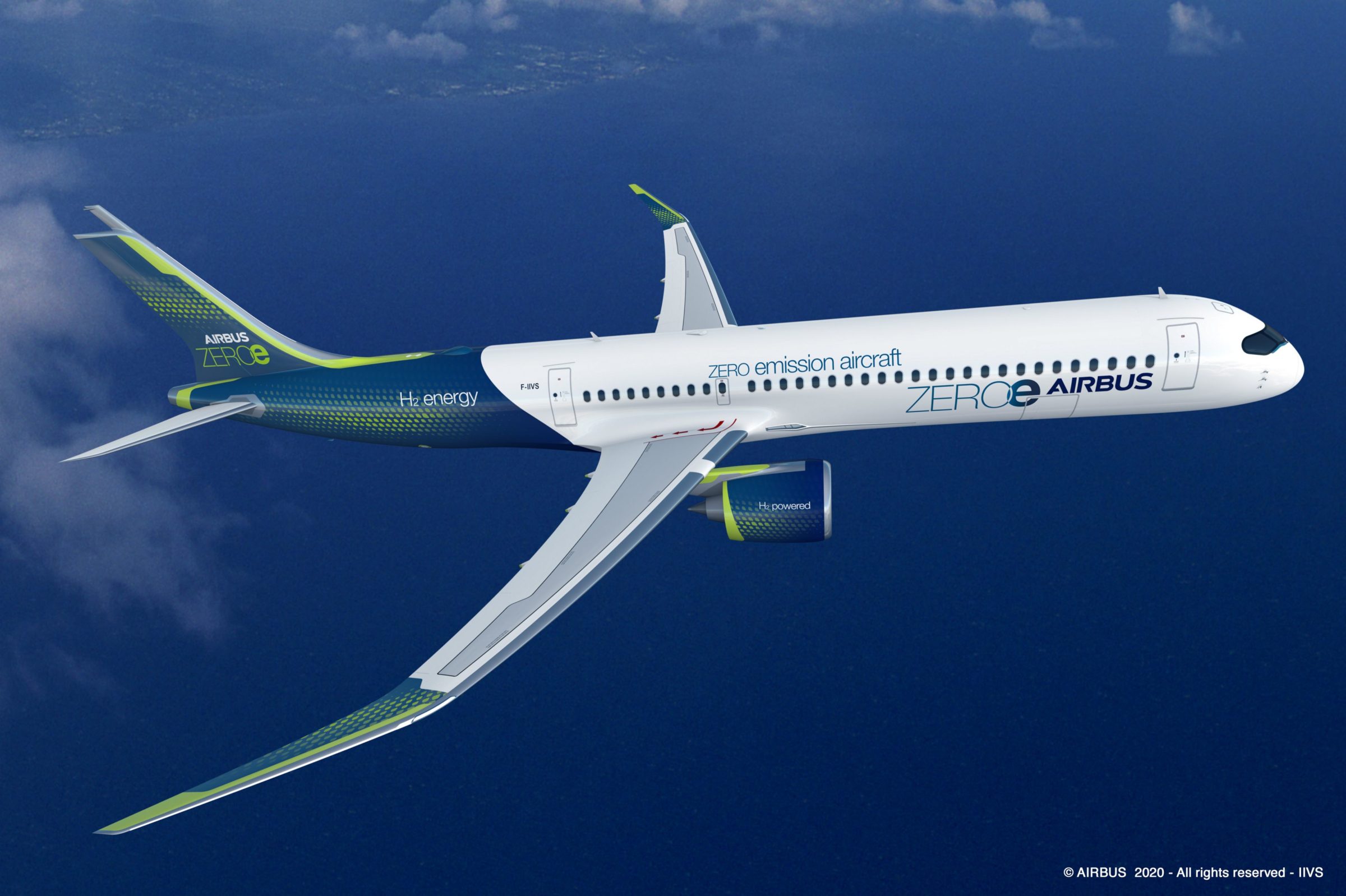
The series arrives at a moment when Boeing's manufacturing quality and program management credibility remain under intense scrutiny from regulators, airlines, and the pilot community. The parallel thread covering alternative propulsion — specifically hydrogen combustion in gas turbines and fuel cell-electric architectures — situates Boeing's recovery challenge within a broader industry transformation. Airbus's ZEROe program, examined in the hydrogen series installment, represents a competitive front where propulsion technology, certification frameworks, and operational infrastructure will all require the kind of rigorous pre-production systems integration that Leeham argues Boeing has historically struggled to sustain. For operators evaluating long-range fleet planning decisions, the convergence of Boeing's recovery trajectory with the industry's alternative propulsion timeline creates compounding uncertainty around future narrowbody and widebody replacement cycles. The Leeham series, though subscription-gated, represents some of the most technically grounded institutional analysis available to pilots and aviation professionals seeking to understand the engineering culture behind the aircraft they fly.






 Read original article