10 Years From Now, This Is What Premium Economy Will Look Like
Premium economy's transformation from a niche upsell into a structural revenue pillar is reshaping how full-service carriers configure, deploy, and justify their widebody fleets. Delta Air Lines now reports that premium economy revenues exceed standard economy yields on the same aircraft and routes—a data point that has effectively ended the industry's long-standing hesitation about cannibalization. Rather than pulling high-yield passengers down from business class, the cabin demonstrably draws travelers up from economy, creating a net positive that no major carrier with a long-haul widebody fleet can afford to ignore. Emirates, Singapore Airlines, Japan Airlines, and Virgin Atlantic are all actively expanding the product across Airbus A350, Boeing 787, and A380 platforms, and the investments in seat hardware, dining, and onboard technology reflect a conviction that demand for elevated in-flight comfort is a durable behavioral shift, not a post-pandemic anomaly.
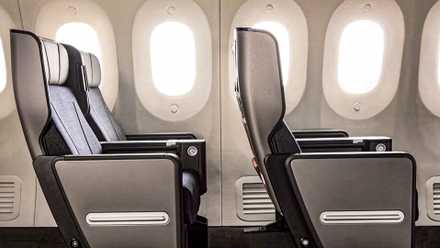
The engineering trajectory described in the article has direct implications for fleet planning and aircraft selection decisions at airlines and their lessors. The current benchmark products—JAL's Sky Premium at 42 inches of pitch with a fixed-shell design and Singapore Airlines' 38-inch pitch paired with 19.5-inch width and six-way adjustable headrests—are being characterized not as aspirational targets but as the minimum expected specifications for any new widebody delivery by 2036. Seat suppliers Collins Aerospace, RECARO Aircraft Seating, and Safran are investing in lighter composite structures and advanced pneumatic lumbar systems capable of recline angles approaching 40 to 45 degrees without the weight penalties that compromise fuel efficiency on next-generation aircraft. For operators evaluating aircraft like the Boeing 787-10 or Airbus A350-1000 on long-haul international routes, the pressure to configure cabins that meet this evolving passenger floor will factor into type selection, interior line-fit decisions, and refurbishment cycle planning.
The aisle-access problem—currently manifesting as the 2-4-2 and 2-3-2 layout constraints that leave window-seat premium economy passengers without direct aisle egress—represents the kind of cabin friction that seat manufacturers and airframers are treating as a solvable near-term engineering challenge rather than an accepted tradeoff. Semi-direct aisle access for every premium economy seat on new-build widebodies is described as a realistic 2036 expectation. This geometric shift will require row-level redesigns that affect cabin density calculations, and operators who execute mid-life refurbishments on existing 787 and A350 frames in the early 2030s will face a choice between investing in forward-looking configurations or accepting a competitive disadvantage on routes where passengers increasingly compare seat-level specifications before booking.
For the broader commercial aviation ecosystem, the premium economy build-out is accelerating route economics in ways that affect pilot operations indirectly but materially. Higher revenue density per square foot of cabin space allows carriers to sustain long-haul flying on thinner demand markets that previously could not support business-class-heavy configurations. That dynamic supports route expansion on widebody equipment—particularly the 787-9 and A350-900, which dominate the table of current top-tier premium economy operators—and it sustains crew demand for wide-body-rated pilots on international operations. For corporate and charter operators watching the commercial market, the premium economy surge is also a signal about traveler psychology: passengers are demonstrably willing to pay meaningfully more for quantifiable comfort improvements, a principle that underpins the continuing resilience of business aviation demand among travelers who ultimately opt out of the commercial cabin experience entirely.








 Read original article