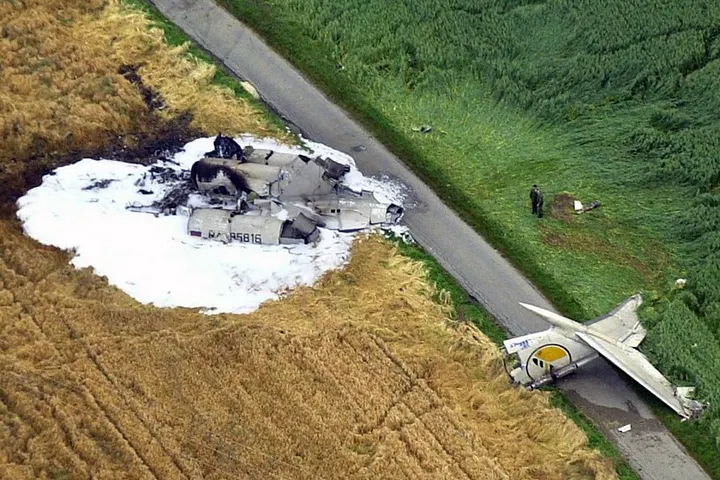
Today is the 24th anniversary of the Überlingen Mid-Air collision. A Bashikrian Airlines Tupolev Tu-154M collided with a DHL Boeing 757 over the town of Überlingen near Lake Constance, resulting in 71 fatalities.
The Überlingen mid-air collision of July 1, 2002, stands as one of the most operationally instructive accidents in modern aviation history, not because of unusual circumstances, but because of how thoroughly routine conditions produced catastrophic results. Bashkirian Airlines Flight BTC 2937, a Tupolev Tu-154M, was carrying 69 people — including 45 Russian schoolchildren traveling to a United Nations peace camp in Barcelona — when it collided at approximately FL360 with DHL Boeing 757-200F Flight DHX 611 over Baden-Württemberg, Germany. Both aircraft were destroyed, and all 71 occupants perished. The collision occurred at night, over German territory but within Swiss-controlled airspace managed by Skyguide, and the chain of failures that produced it was systemic rather than singular.
The operational core of the accident centers on a conflict between TCAS Resolution Advisories and conflicting ATC instructions. TCAS issued coordinated RAs to both aircraft: the Tu-154 received a descend RA and the DHL 757 received a climb RA — a pairing that, if followed, would have resolved the conflict. However, Skyguide controller Peter Nielsen — working alone, managing two sectors simultaneously, with a phone coordination line to adjacent sectors reportedly degraded and the ATC center's backup conflict-alert system offline for maintenance — simultaneously issued a descent instruction to the Tu-154 crew. The Tu-154 crew, presented with an ATC clearance that happened to agree in direction with their TCAS RA, initially responded slowly and then, as the situation evolved, continued following ATC guidance rather than responding to updated TCAS advisories. The DHL crew followed their TCAS RA throughout. The aircraft converged and collided. The accident crystallized a principle that had been theoretically established but operationally ambiguous: when a TCAS RA is issued, flight crews must follow it immediately and without deviation, even when ATC instructions conflict.
For working pilots, Überlingen remains the definitive case study in TCAS RA compliance. The accident drove ICAO and national aviation authorities worldwide to clarify and harden the hierarchy: a TCAS RA supersedes ATC instructions, period. Crews are required to notify ATC of the RA and deviation, but compliance with the RA is non-negotiable and must be immediate. This principle is now embedded in training syllabi, type rating programs, and recurrent simulation scenarios across Part 121, Part 135, and business aviation operations globally. The accident also demonstrated that two independently correct actions — an ATC descent clearance and a TCAS descend RA — could still produce a fatal conflict when coordination between aircraft TCAS systems updated and the crew failed to respond to the revised advisory.
The systemic dimensions of Überlingen extend well beyond the cockpit. Skyguide's operational posture that night reflected staffing vulnerabilities that regulators have since moved to address: a single controller handling traffic that warranted at least two, with degraded tools and no functioning safety net from backup alerting systems. The accident contributed significantly to tightened minimum staffing standards for ATC facilities in European airspace and accelerated investment in redundant collision alerting infrastructure. It also elevated awareness of what investigators termed "automation complacency" on the controller side — an assumption that the system would catch conflicts that human attention missed. The subsequent murder of controller Peter Nielsen by Vitaly Kaloyev, a Russian architect who lost his wife and two children aboard the Tu-154, added a deeply human and legally complex dimension to the accident's aftermath that drew sustained international attention to questions of institutional accountability in ATC operations.
Twenty-four years on, Überlingen continues to appear in crew resource management curricula, TCAS training modules, and ATC human factors research precisely because its failure modes remain active threats. TCAS technology has advanced — TCAS II Version 7.1 and the ongoing development of ACAS X represent significant improvements in resolution logic and coordination — but the fundamental vulnerability the accident exposed persists: human crews operating under time pressure, competing authority signals, and incomplete situational awareness. The accident is not a historical artifact but an active reference case for understanding how the interface between automated safety systems and human decision-making can fail under realistic operational conditions.
 Read original article