RAF A400M Airdrops Medics To World's Most Remote Island For Hantavirus Case
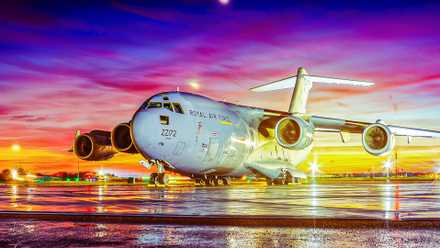
The Royal Air Force executed its first humanitarian airdrop mission in service history on May 10, 2026, deploying six paratroopers and two military clinicians from 16 Air Assault Brigade to Tristan da Cunha — the most remote inhabited island on Earth — in response to a critical hantavirus case that had depleted the island's oxygen supplies. The mission originated at RAF Brize Norton, staging through Ascension Island before the Atlas C.1 (Airbus A400M) flew an additional 1,800-plus miles over open South Atlantic water, completing an aerial refueling rendezvous with a RAF Voyager tanker en route. The total transit covered over 4,200 miles from home base. Upon arriving over the drop zone, the crew airdropped the medical team and 3.3 tonnes of oxygen tanks and medical supplies simultaneously, with personnel exiting the aircraft several miles offshore and riding high-wind conditions — gusting past 25 knots — into a narrow drop zone on the island's edge. All personnel and cargo reached the island safely.
From a purely operational standpoint, the mission illustrates the practical ceiling of long-range airlift capability when no airfield option exists. Tristan da Cunha has no runway, no prepared surface, and no viable emergency landing infrastructure — conditions that eliminate fixed-wing transport solutions entirely and compress the decision tree to parachute delivery or surface vessel transit measured in weeks. The A400M's combination of turboprop endurance, Mach 0.72 cruise speed, air-to-air refueling compatibility, and fly-by-wire precision airdrop systems made it the only viable platform for same-day response. For pilots and operators who work long-range overwater routes or Part 91/135 missions into remote or minimally-equipped destinations, the mission underscores how dramatically the absence of even a basic strip redefines contingency planning — and how air-to-air refueling extends the operational radius of otherwise range-limited airframes into genuinely global reach.
The A400M's performance profile warrants attention on its own terms. The aircraft operates four TP400-D6 turboprop engines driving eight-bladed scimitar propellers, a configuration that delivers both the slow-speed stability required for safe parachute exits and a cruise speed that meaningfully closes the gap with pure-jet transports. Fly-by-wire flight controls and computerized airdrop software — features more commonly associated with advanced commercial airliners than tactical airlifters — enabled precision delivery into a constrained drop zone under adverse wind conditions. This convergence of high-performance turboprop propulsion with digital flight management reflects a broader design philosophy in modern military airlift: platforms that can flex from tactical low-altitude operations to long-haul strategic transit without requiring mission-specific aircraft changes.
The broader significance of Saturday's mission extends beyond the immediate humanitarian outcome. It demonstrates that precision airdrop capability, once considered a narrow special-operations niche, is now embedded in conventional airlift doctrine — a development relevant to any operator or regulator tracking how military airspace users will exercise capabilities in increasingly complex global environments. The RAF's use of Flightradar24-tracked routing also reflects the degree to which even sensitive or unusual military operations now occur within — and are visible through — the same airspace management infrastructure that commercial and business aviation depends on daily. As humanitarian crises increasingly drive rapid-response airlift into remote, runway-deficient locations worldwide, the operational templates developed in missions like Tristan da Cunha will shape how both military and civilian emergency air transport capabilities are structured, funded, and evaluated in the years ahead.








 Read original article