Why The US Air Force's New T-7A Trainer Is Quietly Becoming Its 1st Software-Defined Combat Jet
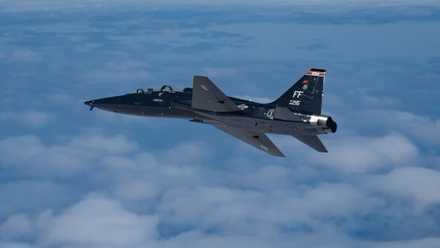
The U.S. Air Force's T-7A Red Hawk program has crossed a significant threshold with its achievement of Milestone C, clearing the way for Low-Rate Initial Production and a $219 million contract covering the first 14 aircraft. This follows more than 500 flight hours of testing and 9,000 recorded data points, giving the program the engineering confidence needed to move from development into fielding. Initial Operating Capability is targeted for summer 2027, with deliveries eventually spanning 351 aircraft and 46 ground-based simulators across five AETC installations—Joint Base San Antonio-Randolph, Laughlin, Sheppard, Columbus, and Vance—over the coming decade. For an Air Force that has relied on the T-38 Talon since the early 1960s, a jet originally sized to prepare pilots for the F-105 and F-4, this represents the most consequential shift in USAF pilot training infrastructure in a generation.
What distinguishes the Red Hawk from previous trainer replacements is not just its airframe performance but its software-defined architecture. Boeing and Saab built the T-7A around an open-systems design that allows avionics, mission systems, and training software to be updated independently of the airframe hardware, mirroring the modular software approach increasingly standard in fifth-generation fighters and being pursued for NGAD-era systems. The fly-by-wire flight control system lets instructors reconfigure aircraft handling qualities in real time, tightening G-limits and response characteristics early in a syllabus and progressively opening the envelope as students advance toward fighter-representative performance. This is a meaningful departure from legacy trainers where handling characteristics were essentially fixed at the factory, and it directly addresses a training gap that has plagued the Air Force for years: new pilots transitioning from the T-38 into F-22s, F-35s, and eventually sixth-generation platforms have faced a steep jump in cockpit complexity, sensor fusion demands, and touch-based large-area displays that the Talon simply cannot replicate.
For working pilots, particularly those in military flight training pipelines or those who later transition to civilian and business aviation careers, this program matters because it signals how quickly avionics philosophy is shifting across the industry. The embedded training concept—simulating weapons employment and complex mission systems without physical ordnance—reduces cost per flight hour while still exposing students to representative sensor and display environments. This same philosophy of software-reconfigurable cockpits and scalable automation is increasingly visible in civilian flight decks, from Garmin's autonomously adaptive avionics suites to Part 25 transport aircraft moving toward more modular certification approaches. Military trainer programs have historically previewed avionics trends that migrate into general aviation and business jet cockpits a decade or more later, and the T-7A's approach to open architecture, rapid software iteration, and reduced life-cycle maintenance costs through standardized data buses is a preview of where flight deck design across all aviation sectors is heading.
More broadly, the T-7A program reflects a defense procurement trend toward commonality, digital engineering, and reduced total ownership cost, themes that resonate well beyond military aviation. The aircraft's ability to evolve through software rather than requiring wholesale hardware redesign addresses the chronic problem of trainer aircraft becoming obsolete relative to frontline platforms, a mismatch that has plagued the T-38 relationship with fifth-generation jets for over a decade. As the Air Force works through supply chain and schedule challenges that have delayed the program from its original 2024 IOC target, pilots, maintainers, and training commanders alike will be watching closely, since the Red Hawk's success or failure will shape not only how the next generation of fighter pilots is built, but also how quickly software-centric design philosophies proliferate into training and operational fleets across both military and civilian aviation.








 Read original article