Starlink doubles business aviation prices, adds regional locking | Corporate Jet Investor | CJI news
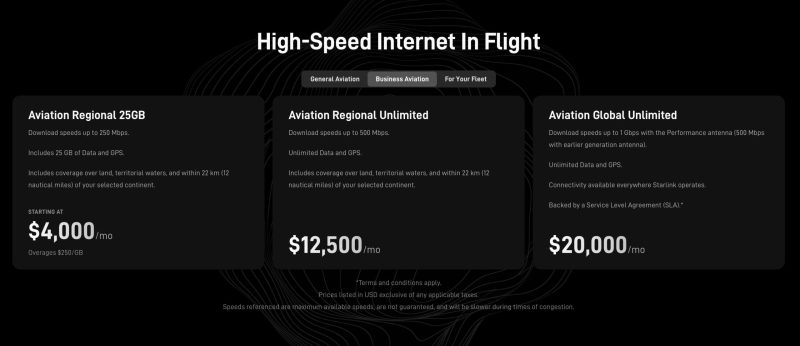
SpaceX has announced a sweeping restructuring of its Starlink Aviation pricing that effectively doubles the cost of its most popular connectivity tier while introducing geographic restrictions that didn't previously exist. Effective August 7th, the former $10,000/month unlimited global plan has been discontinued and replaced by "Aviation Global Unlimited" starting at $20,000/month—still offering true global coverage (up to 1 Gbps with the performance antenna) but backed by a formal service level agreement. Beneath it sits a new "Aviation Regional Unlimited" tier at $12,500/month, capped at 500 Mbps and geographically restricted to a single continent chosen by the customer, plus territorial waters and 12nm of coastal buffer. Even the entry-level plan has doubled, from $2,000 to $4,000/month, now bundled with a 25GB data cap and GPS but the same regional coverage limitation as the mid-tier product. On top of the service price hikes, SpaceX raised hardware costs from $145,000 to $200,000 per aircraft—a 38% jump that compounds the total cost of ownership for operators either installing new systems or budgeting for fleet-wide rollouts.
For flight departments and charter operators, this repricing fundamentally changes the connectivity value proposition that made Starlink so disruptive in the first place. Since entering the business aviation market, Starlink's appeal was built on offering fiber-like speeds at a fraction of the cost of legacy Ka- and Ku-band systems from providers like Gogo, Viasat, and Honeywell/Inmarsat. Doubling the unlimited plan to $20,000/month starts to close that gap, particularly for operators who fly transoceanic or intercontinental routes and now must either pay the premium global rate or accept the regional cap—which could leave an aircraft without service mid-Atlantic or mid-Pacific if it wasn't provisioned for global coverage. Flight departments that based purchasing decisions and long-term connectivity budgets on last year's pricing will need to revisit those assumptions immediately, especially with less than a month's notice before the new rates take effect on August 7th.
The regional locking mechanism is arguably the more consequential change for international operators. Business jets routinely reposition across continents for maintenance, charter repositioning, or owner travel patterns that don't respect a single "selected continent." An operator based in Europe who occasionally flies to the Middle East, Asia, or the Americas would need to either upgrade to the global tier or manage plan changes dynamically—a level of complexity that legacy inflight connectivity providers have typically avoided through their own global service agreements. This is a meaningful operational consideration for international business aviation, fractional operators, and charter management companies that market global reach as a core value proposition to clients.
Despite the price shock, the anecdotal report of increased installation inquiries suggests demand remains resilient, at least in the near term. This reflects a broader trend in business and general aviation connectivity: even at doubled prices, LEO satellite service still often undercuts legacy VSAT and Ku-band systems on both bandwidth and total cost, while offering markedly better latency for video conferencing, real-time weather, and cabin Wi-Fi expectations that have become standard in the post-pandemic business jet market. The move also signals SpaceX's broader pricing strategy across its Starlink product lines—commercial maritime and enterprise customers have seen similar adjustments—as the company balances rapid market share gains against the capital costs of expanding satellite constellation capacity. For aviation operators, the takeaway is that connectivity costs, once assumed to be a fixed and shrinking line item thanks to LEO competition, are proving just as susceptible to repricing pressure as any other aircraft operating cost, reinforcing the need for flexible contracts and careful long-term budgeting rather than assuming today's rates will hold.