Electra secures the FAA certification basis that eVTOL developers wanted
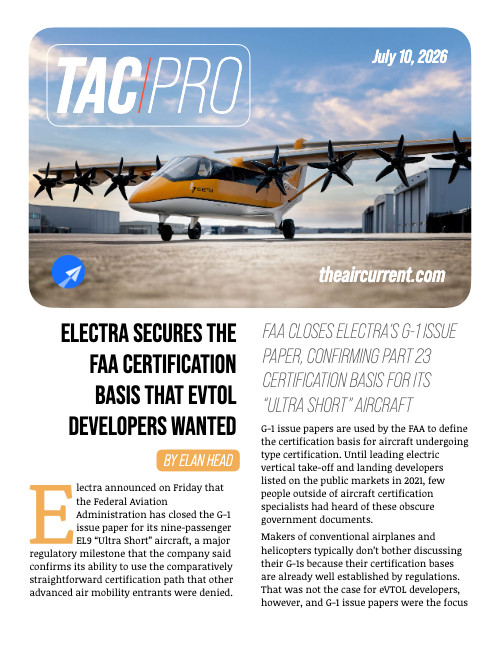
Electra's announcement that the FAA has closed the G-1 issue paper for its nine-passenger EL9 "Ultra Short" aircraft marks a significant regulatory milestone in the advanced air mobility (AAM) sector, one that the company argues validates a certification approach that regulators denied to many of its eVTOL competitors. The G-1 issue paper is the foundational document the FAA uses to establish the certification basis for a new aircraft type—essentially the rulebook against which the design will be evaluated for airworthiness. For conventional fixed-wing aircraft and helicopters, this process is routine and rarely newsworthy because the applicable regulations (Part 23, Part 25, Part 27, Part 29) are well established. Electra's EL9, a hybrid-electric short takeoff and landing (eSTOL) aircraft, is being certificated under existing Part 23 commuter category rules with special conditions, rather than the novel "powered-lift" category the FAA created for eVTOL aircraft like those from Joby, Archer, and others.
The distinction matters enormously to industry watchers and, by extension, to pilots who may eventually fly or interact with these aircraft. In 2022, the FAA abruptly reversed course on how it would certify eVTOL aircraft, shifting several major players from an expected Part 23-based special class approach to the more novel and less-precedented "powered lift" category under Part 21.17(b). That reclassification triggered substantial engineering rework, schedule slips, and cost overruns for companies like Joby and Archer, and became a flashpoint in the SPAC-era AAM boom when investors and analysts scrutinized certification risk far more closely than in traditional aerospace financing. Electra's STOL approach—relying on distributed hybrid-electric propulsion and blown-lift aerodynamics to achieve very short runway performance without full vertical lift capability—allowed it to stay within a certification basis that regulators, engineers, and airlines already understand, sidestepping the same bureaucratic novelty that slowed eVTOL rivals.
For working pilots, particularly those in regional, cargo, and business aviation, this development is a signal of where near-term commercial adoption of electric and hybrid-electric aircraft is most likely to occur. eSTOL aircraft like the EL9 are being pitched for point-to-point regional connectivity, cargo feeder routes, and even military logistics, operating from short unimproved strips near underserved communities—markets that don't require the full vertical-lift complexity (and certification uncertainty) of eVTOL air taxis. A cleaner, faster path through FAA certification means EL9 could reach commercial service meaningfully sooner than pure eVTOL competitors, some of which are now targeting entry-into-service dates in the late 2020s after years of delay. Pilots transitioning into these platforms will encounter hybrid-electric powerplant management, distributed propulsion systems, and STOL-specific handling characteristics, but within a more familiar Part 23 operational and training framework rather than an entirely new powered-lift category with its own novel pilot certification requirements still being worked out by the FAA.
More broadly, this milestone underscores a maturing realism within the AAM sector after several years of overpromising and regulatory whiplash. Companies that bet on incremental, evolutionary certification paths—leveraging existing regulatory categories rather than lobbying for entirely new ones—appear to be gaining a competitive and financing advantage as investor patience for speculative "flying car" narratives has thinned. For airline, business jet, and charter operators evaluating future fleet diversification, Electra's progress suggests that hybrid-electric STOL aircraft may reach the ramp before eVTOL air taxis do, reshaping near-term expectations for where electrified propulsion first makes an operational and economic dent in commercial aviation.