The US Air Force Just Asked For $1.7 Billion To Keep The B-1 & B-2 Flying Because The B-21 Raider Won't Arrive Fast Enough
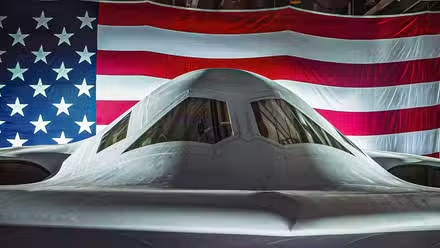
The U.S. Air Force's decision to invest $1.7 billion over the next five years to sustain the B-1B Lancer and B-2 Spirit fleets underscores a widening gap between strategic bomber requirements and the pace of B-21 Raider production. Rather than retiring these legacy platforms in the early 2030s as previously planned, the service is now funding modernization programs to keep them mission-capable well beyond that horizon. The allocation itself is telling: $1.35 billion will go toward the 19-aircraft B-2 fleet, while just $342 million is earmarked for the 44-strong B-1B fleet. That roughly 10-to-1 per-airframe disparity signals a clear prioritization of stealth penetration capability and nuclear delivery over the B-1's larger payload and conventional strike flexibility—a reflection of how the Pentagon views the threat environment shaped by advanced integrated air defense systems fielded by peer adversaries.
For working pilots and aviation operators, this development is a case study in the friction between defense acquisition timelines and operational readiness demands. Even with Northrop Grumman and the Air Force accelerating B-21 production by 25 percent—backed by more than $5 billion in digital engineering investment and a supply chain spanning 400+ suppliers across 40 states—the math of fielding a fleet of 100 new bombers simply cannot outpace the near-term need for deep-strike capacity. This mirrors a broader pattern across military and commercial aviation alike: aircraft certified and building toward initial operational capability rarely arrive fast enough to allow clean, immediate retirement of the platforms they're meant to replace. Airline operators navigating delayed narrowbody and widebody deliveries from Boeing and Airbus will recognize the dynamic instantly—legacy fleets get extended service-life programs, engine overhauls, and avionics upgrades not because they're ideal, but because the alternative is a capability gap nobody can afford.
The B-2's continued centrality also has implications for how flight crews and maintenance organizations plan around aging low-observable airframes. Colonel Mark Gunzinger's comments—that the B-2 remains "the only fully operational stealth bomber" and that long-range penetrating strike is "one of the most significant shortfalls" in current U.S. military capability—highlight why sustainment dollars are flowing disproportionately toward the Spirit fleet despite its small size and high per-unit operating cost. Stealth coatings, low-observable maintenance regimes, and the B-2's unique ability to carry both nuclear weapons and the 30,000-lb GBU-57 Massive Ordnance Penetrator make it operationally irreplaceable in the near term, even as it approaches nearly four decades of service life by the time the B-21 reaches meaningful numbers.
More broadly, this bomber sustainment story fits into a familiar aerospace industry pattern: platforms nearing retirement age get one more infusion of capital to bridge a gap created by next-generation program delays, cost growth, or manufacturing ramp-up constraints. Ellsworth Air Force Base's designation as the B-21's first operational home in 2027 shows the transition is real and underway, but the parallel investment in B-1 and B-2 sustainment confirms that legacy-to-next-generation fleet transitions in aviation—whether military bombers or commercial jetliners—are rarely as fast or clean as program milestones initially suggest. For pilots, maintainers, and program planners across the industry, the B-1/B-2/B-21 overlap is a reminder that fleet transition planning must always build in margin for schedule slip, production ramp challenges, and the reality that "legacy" aircraft often fly years, if not decades, longer than originally advertised.





 Read original article