How This Airline Packs 39 Business Class Seats Into A 17-Hour Flight Nobody Talks About
EVA Air's approach to the Taipei-North America corridor illustrates a business class strategy that diverges meaningfully from the industry's dominant ultra-long-haul playbook. While carriers like Singapore Airlines and Qantas have built their premium narratives around record-breaking flight durations—Singapore's nonstop to New York and Qantas's Project Sunrise routes to London and New York exceeding 19 hours—EVA has instead optimized for density on flights that, while still grueling at 15 to 17 hours, sit just under the threshold that generates headlines. The carrier's 777-300ERs configured with 38 to 39 Royal Laurel business class seats in a 1-2-1 reverse herringbone layout represent a meaningfully higher premium cabin count than what's typically found on comparable widebody long-haul aircraft from competitors, where business class counts in the 30s are common but rarely push toward 40 seats on a single aircraft. This is a volume play built on structural demand rather than marketing distinction.
The economic logic underpinning this strategy is straightforward and instructive for network planners across the industry: Taiwan's centrality to global semiconductor supply chains creates a dense, inelastic, and premium-fare-tolerant traveler base between Taipei and US business hubs like Chicago, Dallas, Houston, and the newly added Washington Dulles. This is business travel driven by R&D partnerships and corporate necessity, not leisure premium upsell, which explains why EVA can sustain such an unusually high ratio of business seats to total capacity across multiple North American routes simultaneously rather than on a single showcase flight. For working pilots, particularly those flying long-haul international for major carriers, this underscores how crew scheduling, fatigue risk management, and augmented crew requirements are increasingly shaped not just by stage length but by cabin configuration and passenger mix—a densely packed premium cabin on a 17-hour sector creates different service tempo and crew rest dynamics than a leisure-heavy configuration of similar duration.
EVA's fleet transition also reflects a broader inflection point playing out across long-haul operators. The airline's decision to convert 777-300ERs to freighters, order 24 Airbus A350-1000s, and notably bypass the Boeing 777X entirely signals a hedging strategy amid continued uncertainty around the 777X's delayed certification timeline and Boeing's ongoing production and quality-control challenges. Airlines with aging 777-300ER fleets are increasingly voting with their order books, and EVA joining the list of carriers favoring the A350-1000 over the 777X adds to mounting evidence that Boeing's widebody delays are reshaping long-haul fleet planning industry-wide, with knock-on effects for pilot type-rating pipelines, training footprints, and long-term fleet commonality decisions at carriers watching from the sidelines.
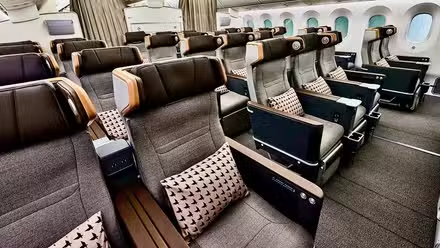
Finally, EVA's historical role as the originator of true premium economy—predating and arguably outclassing claims often credited to Virgin Atlantic—is a reminder that mid-tier cabin innovation continues to be an underappreciated lever in long-haul competitiveness. The carrier's move to a 2-3-2 fourth-generation premium economy product on its 787-9s, with 42-inch pitch and 8 inches of recline, reflects an industry-wide recognition that the willingness of passengers to pay a 20-30% premium for enhanced comfort is durable and growing, particularly on sectors where economy comfort limits are tested by mission length. For corporate and business aviation operators tracking cabin trends, EVA's dual bet—maximizing business class density on ultra-long routes while simultaneously refining premium economy as a distinct product—illustrates that competitive differentiation in long-haul markets is increasingly about matching cabin architecture to specific demand profiles rather than chasing record-setting range statistics alone.





 Read original article